
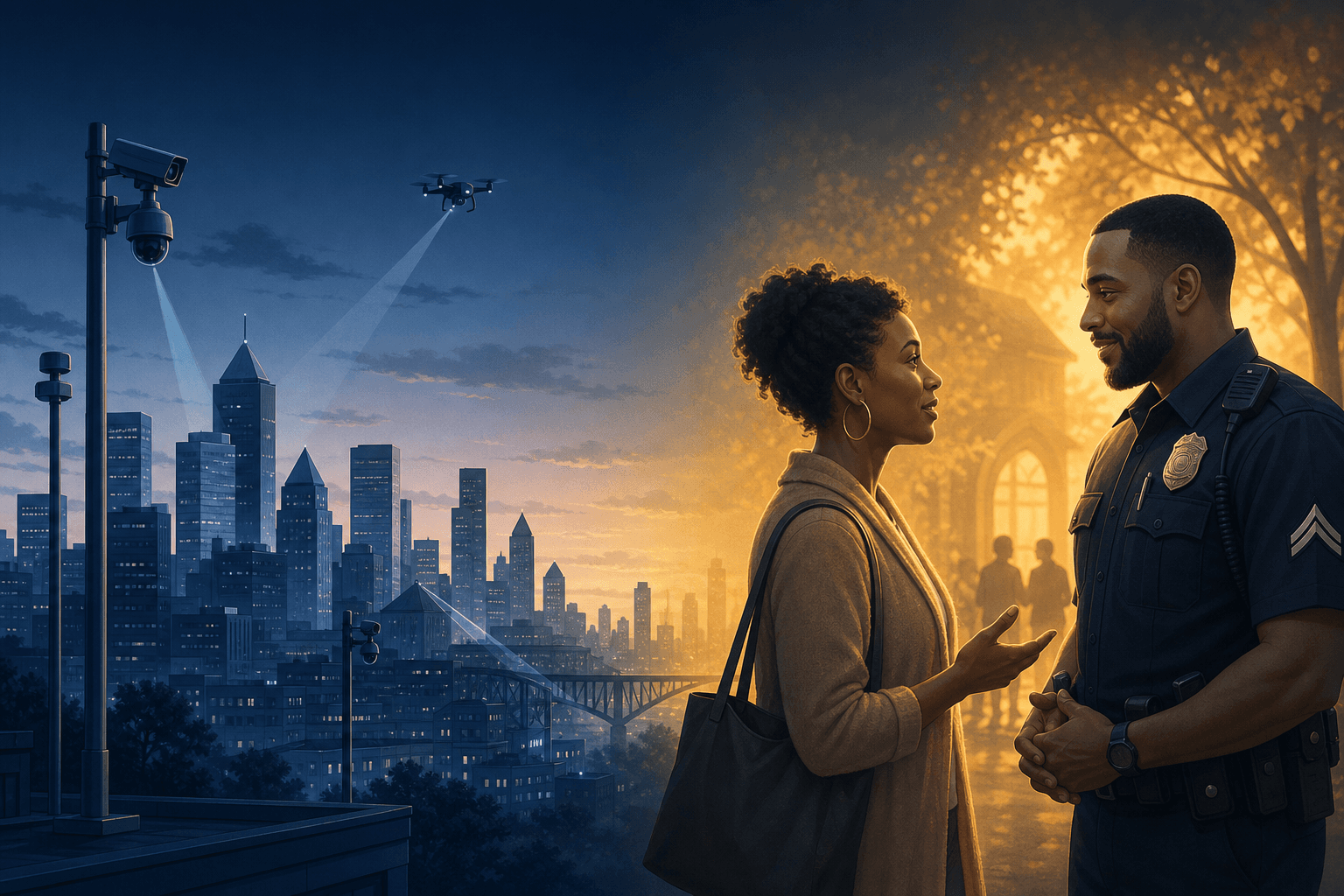
Walk the exhibit hall at any major police conference and you can see exactly where the money in police technology is heading. Camera networks that blanket a downtown. License plate readers on every corridor into town. Drones marketed as first responders. Artificial intelligence that transcribes and summarizes hours of body-camera footage in seconds. Booth after booth promising to see more, retain more, and miss less.
Call this the technology of watching. It is genuinely sophisticated, it is growing fast, and the industry is investing billions to make it sharper every year.
There is a second kind of police technology, though, and it is almost absent from that exhibit hall. It is quieter and far cheaper. It does not observe the community. It asks the community. After years as an officer and now years building in this space, I have become convinced that the future of police legitimacy depends far more on the asking than on the watching.
Two questions, two categories
Every police technology, underneath the branding, serves a question. The technology of watching answers a factual one: what happened, and who did it? Cameras, readers, and analytics extend the agency's eyes. They gather information about people, usually without those people's participation, and often without their knowledge.
The technology of asking answers a very different question: how are we doing, according to the people we serve? Surveys, feedback systems, and sentiment tools gather information from people, with their consent, at their discretion, and with their anonymity protected.
The distinction sounds academic until you sit with it. Watching treats the community as a source of evidence. Asking treats the community as a source of judgment. One direction of data flow builds cases. The other builds legitimacy. Both are real, but they are not interchangeable, and no amount of investment in one produces the other.
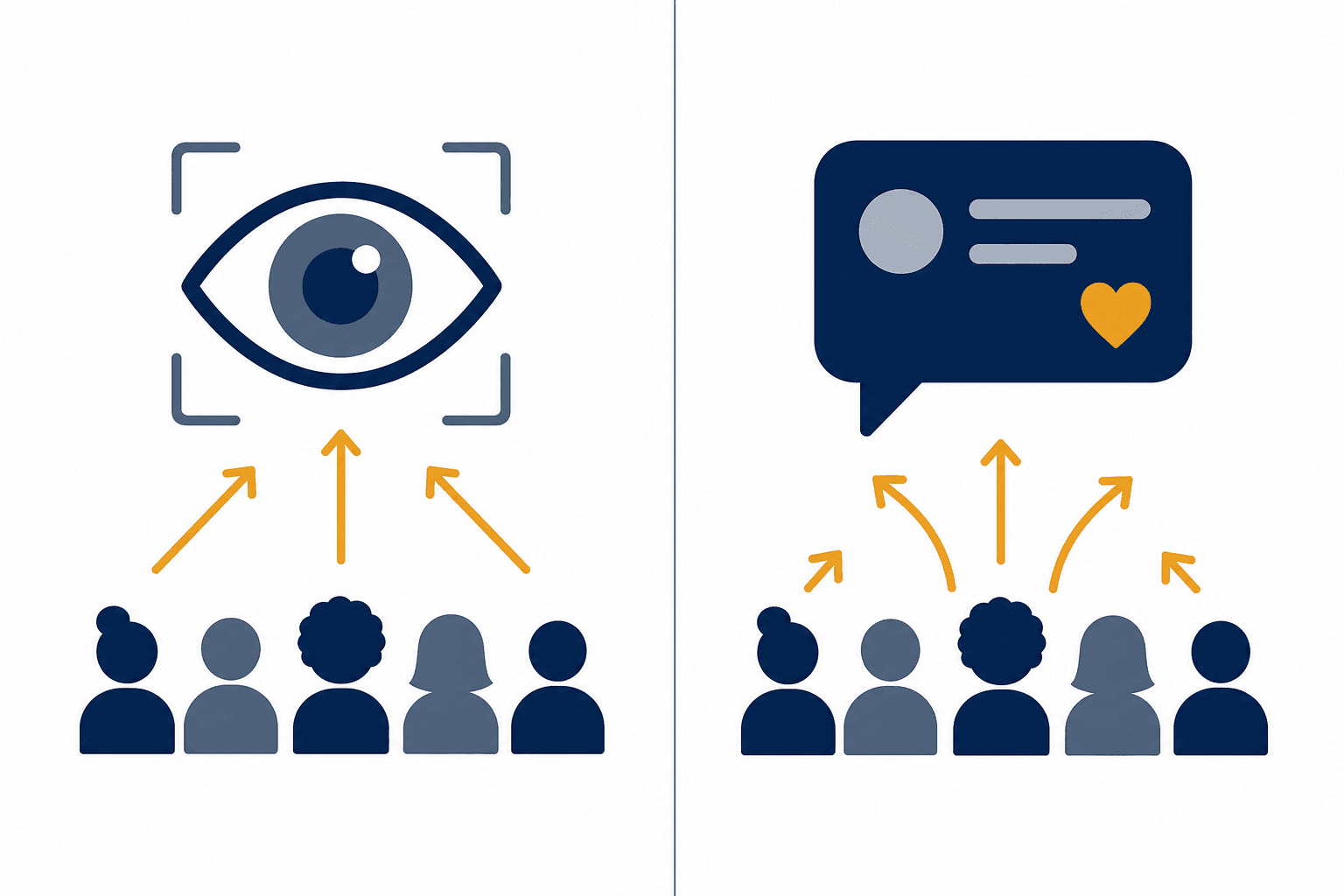
Watching collects information about the community. Asking collects information from it. The direction of the arrow is the whole argument.
Consider the scale of what goes unasked. The Bureau of Justice Statistics estimates more than 60 million police-community contacts every year in the United States. A growing share are recorded, transcribed, and stored. Almost none are followed by a single question to the person who lived through them: how did that go? We have built an extraordinary apparatus for remembering what happened, and almost nothing for understanding how it felt to the public we serve.
To be clear, watching has a role
This is not an argument against investigative technology. I spent years as a police officer, and I know exactly what it means to have the tool that finds the stolen car, identifies the hit-and-run driver, or corroborates an officer's account against a false claim. Evidence technology solves crimes, protects good officers, and gives prosecutors what they need to do their jobs. Communities benefit from all of it, and most residents genuinely want the crimes in their neighborhood solved.
The problem is not that watching exists. The problem is imbalance. When an agency's entire technology stack points outward, observing, recording, and analyzing the public, while nothing invites the public to evaluate the agency, the message lands whether or not anyone intends it: we collect data about you, never from you. Every camera can deter a crime. No camera has ever made a resident feel respected during a traffic stop.
Respect during that stop is what actually moves trust. Decades of procedural justice research show that people judge the police less by the outcome than by how they were treated, by whether the officer explained the reason, listened, and acted fairly. Surveillance cannot detect any of that. Only the person on the other side of the encounter can tell you, and only if someone thinks to ask.
What asking looks like when it is done right
Asking has its own design standards, and they matter as much as the decision to ask in the first place. Get them wrong and you produce noise that erodes confidence on both sides of the badge.
Consent and anonymity come first. A feedback system should collect no personally identifiable information. The community member decides whether to respond, and nothing they say can be traced back to them. That protects residents, protects officers from feedback being weaponized, and keeps the data honest enough to act on.
Verification separates signal from noise. An open web form invites anyone with an opinion, including people who never met the officer in question. A verified system, for example a single-use card or QR code handed over at the end of a real encounter, ensures every response maps to an actual interaction. That difference is what makes the data usable for coaching and reporting instead of venting, and I dig into it further in community surveys versus interaction feedback.
The questions measure behaviors, not vibes. Asking "do you trust the police?" mostly measures the national news cycle. Asking "did the officer explain why you were stopped?" measures your officer, on your street, on that day. Behavior-level questions produce data an agency can actually move, which is the foundation of any serious attempt to measure community trust.
When those standards are met, something worth noticing happens: the community says far more good than bad. Across agencies using Guardian Score, the average rating is 4.7 out of 5, and roughly two-thirds of surveys include written comments. People have been waiting for a legitimate way to say "this officer treated me well." Watching technology will never capture that sentence. Asking technology captures it every single day.

The agencies that lead are not choosing a side. They are rebalancing the scale, keeping the tools that solve crimes and adding the ones that build trust.
Legitimacy is the return on asking
Here is the strategic point for any chief weighing a budget. Watching technology, at its best, improves clearance rates and deterrence. Asking technology, at its best, improves the thing that makes everything else easier: legitimacy, the community's underlying belief that the police deserve cooperation.
There are early signs the climate is ready for this. Gallup found that confidence in police rose from 43 percent in 2023 to 51 percent in 2024, the largest gain of any institution it measured (Gallup). That recovery is fragile, and it will not be sustained by adding more cameras. It will be sustained by millions of individual encounters that leave people feeling heard, and by the agencies that can prove it with data they can put in front of the council.
The agencies I admire most are not choosing between the two futures at all. They are rebalancing. They keep the investigative tools that solve crimes, and they add the feedback tools that build the trust that makes crime-solving possible in the first place. Witnesses come forward in neighborhoods that trust the police. Tips flow to agencies people believe in. Asking is not the soft option. It is operational.
There is a budget argument riding alongside the moral one. The asking side of the ledger costs a small fraction of the watching side, with no camera poles, no server farms, and no multi-year integration project. For the roughly 18,000 U.S. law enforcement agencies, most of them staffed by fewer than 50 officers, asking is the rare technology investment that is actually within reach, and the return shows up in the one metric that governs everything else.
What you can do Monday
Take an inventory of your agency's technology budget and sort every line item into two columns: tools that collect information about the community, and tools that collect information from it. Most command staffs discover the second column is empty. Then pick a single unit and pilot the asking side. Even a simple verified survey after routine encounters will start generating the one dataset no camera can produce: how the people you serve say you are doing, in their own words.
Guardian Score is technology that asks, delivering verified, anonymous, per-interaction community feedback built on procedural justice. If your stack watches but never asks, book a demo and see what the other future looks like.
Frequently asked questions
What is the difference between surveillance technology and community feedback technology in policing?
Surveillance technology, such as cameras, plate readers, and AI transcription, collects information about the community, usually without its participation, to answer what happened and who did it. Feedback technology collects information from the community, with consent and anonymity, to answer how the police are performing according to the people they serve.
Does community feedback technology replace cameras and investigative tools?
No. Investigative technology solves crimes, protects officers from false accusations, and supports prosecutions. Feedback technology addresses a different outcome, legitimacy, which surveillance cannot measure. Well-run agencies balance both instead of choosing one.
Do communities actually respond when police ask for feedback?
Yes. Across agencies using Guardian Score, the average rating is 4.7 out of 5, more than 1.25 million community members have been served, and roughly two-thirds of surveys include written comments, most of them describing what officers did well.