

"We already do a survey."
It is the most common thing a chief says when the conversation turns to measuring community trust, and it is half right. If your agency runs a periodic community survey, you are already ahead of most departments. The President's Task Force on 21st Century Policing recommended back in 2015 that agencies "track the level of trust in police by their communities just as they measure changes in crime" (Recommendation 1.7), and a decade later, most still do not.
The half that is wrong is the quiet assumption underneath it: that one instrument can answer every question worth asking. A benchmark survey and interaction-level feedback measure different things, on different clocks, at different resolutions. Treating them as interchangeable is like treating an annual physical as a substitute for a heart-rate monitor. Both are useful. Neither replaces the other.
What follows is an honest comparison of the four main ways agencies collect community feedback, what each one can tell you, what each one cannot, and why the mature programs stop choosing between them.
What a police community survey actually measures
A traditional community survey, whether mailed, phoned, or pushed to a resident panel once a year or once every two, measures general sentiment across the whole population. That includes the large majority of residents who had no police contact at all in the period. The breadth is genuinely valuable. It tells you how the agency is perceived, it lets you compare year over year, and it satisfies accreditation requirements like CALEA Standard 2.6.5, which calls for a documented citizen-attitude survey at least every two years.
What it cannot do is tell you anything about a specific encounter, a specific officer, or the last thirty days. General sentiment is heavily colored by national news cycles no local chief controls. And by the time an annual survey surfaces a problem, that problem is already at least a year old.
Interaction feedback works from the opposite end of the telescope. The Bureau of Justice Statistics counts more than 60 million police-community contacts in the United States every year: traffic stops, calls for service, community events. Each one is a data point about how an officer actually treated someone. Feedback gathered at that level measures experience rather than opinion, and it arrives continuously instead of biennially.
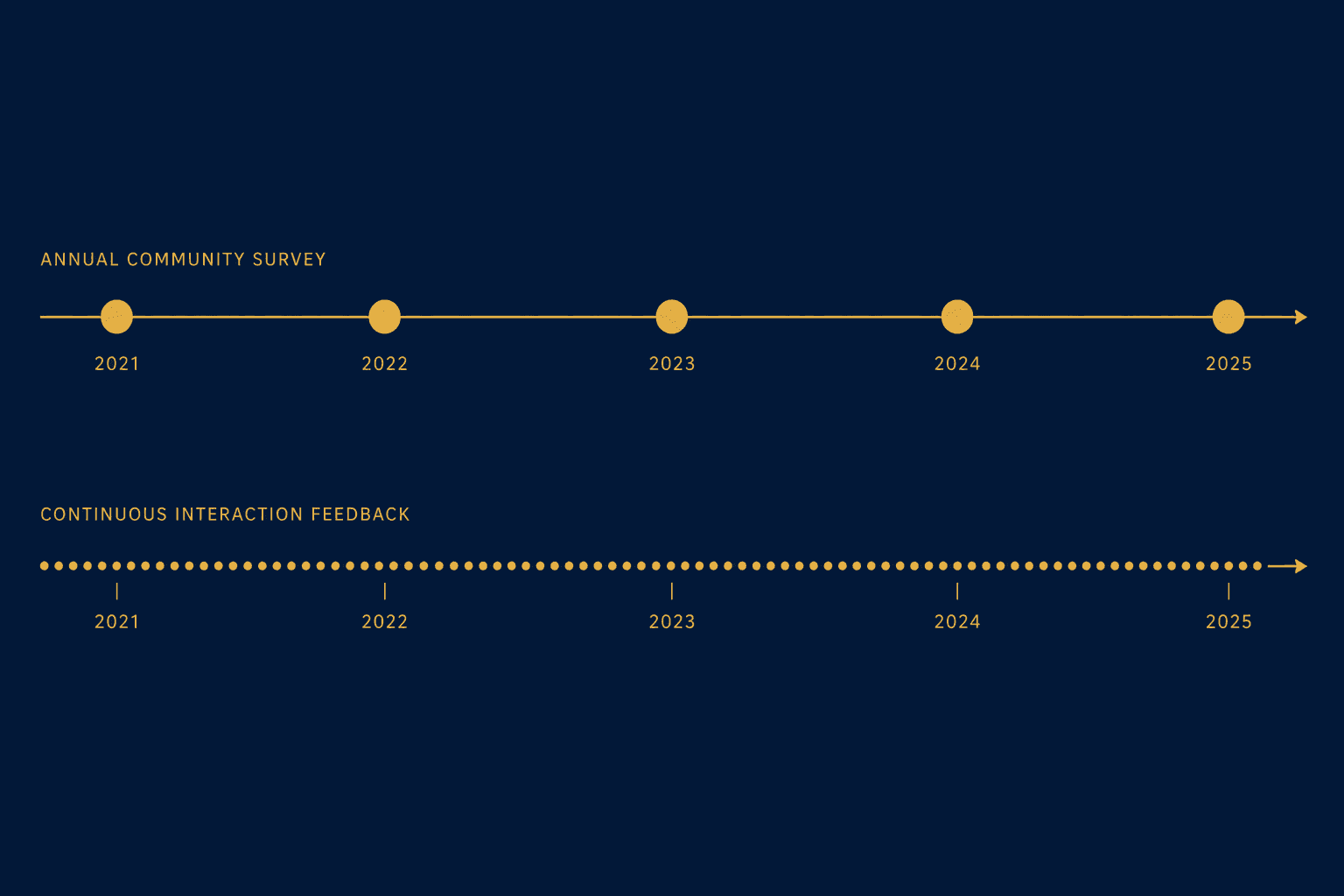
A benchmark survey samples sentiment once a year. Interaction feedback captures experience continuously, encounter by encounter.
Neither is a substitute for the other, because they answer different questions.
Four ways to collect feedback, compared honestly
Agencies today choose among four broad categories. Here is what each one answers, and what it structurally cannot.
| Approach | What question it answers | What it cannot tell you | | --- | --- | --- | | Periodic benchmark survey | "How does the whole community, including non-contacts, feel about us this year?" | Nothing about specific interactions or officers; results lag reality by months; low response rates skew toward the most motivated residents | | Social-media sentiment analysis | "What is being said about us publicly right now?" | Whether posters ever interacted with your officers; sentiment is dominated by national events and a vocal minority; no officer-level signal | | Automated post-contact surveys (text or email from CAD/RMS data) | "How did people we have contact records for rate the encounter?" | Anything about contacts that never generated a record; requires IT integration; identified respondents may soften honest criticism | | Per-interaction verified feedback (single-use card handed by the officer) | "How did this specific, real encounter go, behavior by behavior, officer by officer?" | Community-wide sentiment among residents with no police contact; long-term perception shifts across the whole population |
Every row has a real limitation, including the last one. Verified per-interaction feedback is the highest-resolution tool on the list, but it only hears from people who actually met your officers. If you want to know how the roughly 80 percent of residents with no police contact feel, you still need a benchmark survey. That is the point, not a caveat. These are complementary instruments, not rivals.
Why a survey alone cannot manage trust
Think about what a chief actually needs in order to manage trust, not merely report on it once a year.
An annual survey hands you a department-level number. It cannot tell you that listening scores in one squad slipped this quarter, that a single officer's fairness ratings have drifted down for three months, or that your newest cohort explains next steps better than your veterans do. Those are the findings that drive coaching, recognition, and early intervention, and they only come from feedback tied to individual, verified encounters.
Resolution is one gap. Volume and honesty are the others. Verified programs built on single-use QR interaction cards tend to see completion and candor that periodic instruments rarely reach: across agencies using Guardian Score, roughly 86 percent of started surveys are finished, about two-thirds include a written comment, and the average rating sits at 4.7 out of 5. Anonymity paired with verification is why. Respondents know their feedback maps to a real encounter, and officers know a stranger on the internet cannot flood the system.
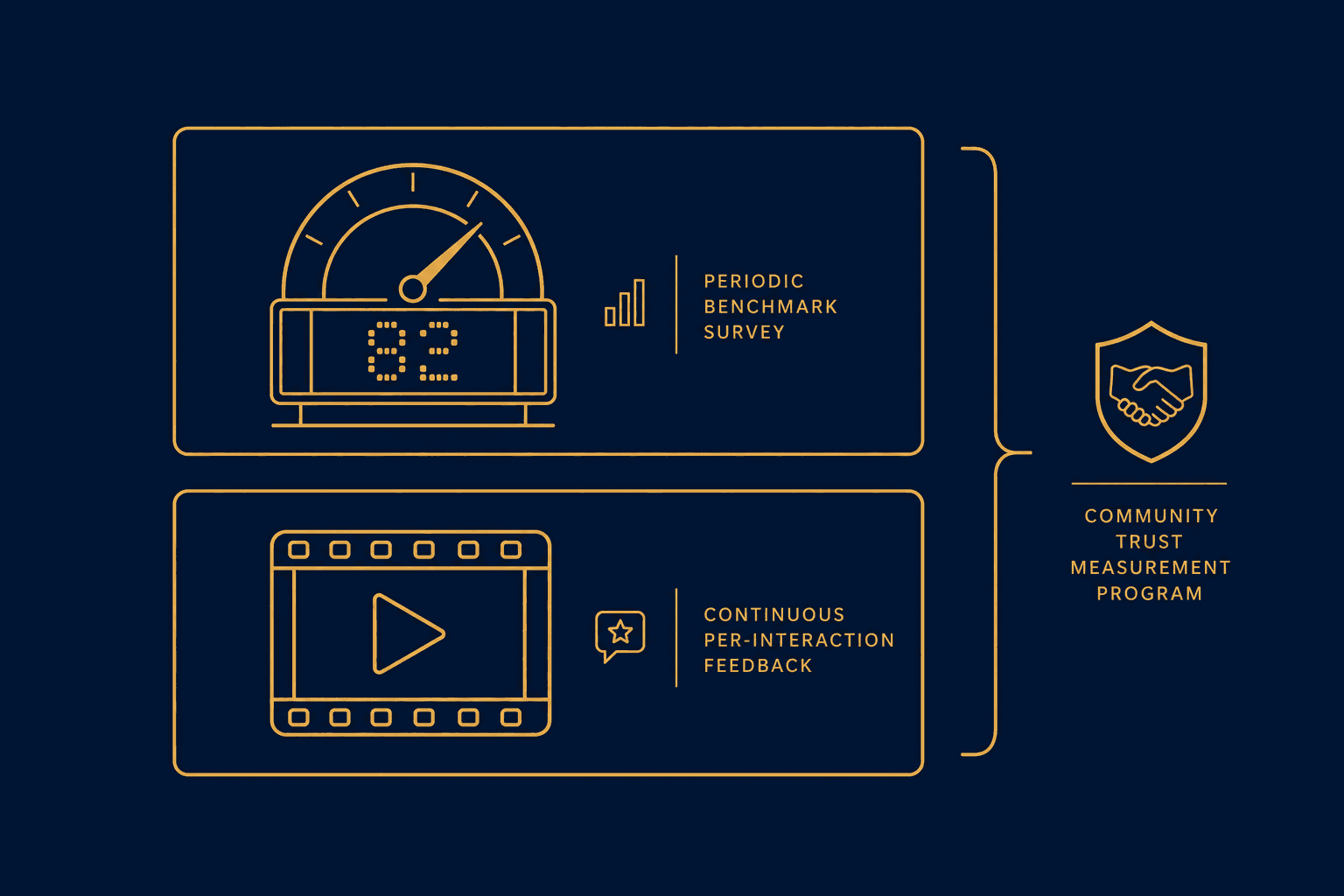
The survey is the scoreboard. Interaction feedback is the game film. A serious program runs both.
The layered model is simple to describe. Keep, or start, a benchmark survey every one to two years to track population-wide sentiment and satisfy accreditation. Run continuous interaction feedback in between to manage the behaviors that actually move that sentiment. The survey is the scoreboard. Interaction feedback is the game film. For the full framework, see our guide on how to measure community trust in policing.
An eight-question buyer's checklist
If you are evaluating any feedback approach, a survey vendor, a sentiment platform, or an interaction feedback system, these eight questions surface the real differences fast.
- Is every response tied to a verified, real interaction, or can anyone submit? Open portals collect grudges and bots alongside genuine feedback.
- Is the respondent anonymous? Identified feedback runs politer and thinner. Anonymity protects the community member and improves honesty.
- What resolution does the data offer, department only or officer and squad level? A single citywide number is a press release, not a management tool.
- How fresh is the data? Annual results describe last year. Continuous feedback describes last week.
- What behaviors does it measure? Look for the procedural justice behaviors research links to legitimacy, not just overall satisfaction.
- What does deployment ask of your IT staff? CAD and RMS integrations can take months. A card-and-dashboard model asks for none.
- Does it capture positive interactions, or only complaints? Recognition-worthy work vastly outnumbers complaint-worthy work, and your data should reflect that.
- Will the output satisfy accreditation and council reporting? Documented methodology and exportable reports turn feedback into evidence. Our guide to CALEA accreditation and community feedback covers what assessors look for.
The agencies that get trust measurement right are not the ones that found a single perfect instrument. They are the ones that stopped looking for it. A benchmark survey tells you where you stand with the whole community. Interaction feedback tells you, week by week and officer by officer, how you are earning or losing that standing. Put the two together and you can finally answer the question the task force posed a decade ago: not just whether trust is up or down, but why, and what to do about it on Monday.
Frequently asked questions
What is a police community survey?
A police community survey is a periodic questionnaire, typically annual or biennial, that measures general public attitudes toward an agency across the whole community, including residents who had no police contact. It establishes a sentiment baseline and supports accreditation requirements such as CALEA Standard 2.6.5.
What is the difference between a community survey and interaction feedback?
A community survey measures population-wide opinion once a year or less, while interaction feedback measures how specific, verified encounters actually went, continuously and at the officer level. Surveys track perception; interaction feedback tracks the behaviors that shape perception.
Should a police department replace its annual survey with interaction feedback?
No. Mature programs layer both: a benchmark survey every one to two years for population-wide sentiment and accreditation evidence, plus continuous per-interaction feedback for officer-level coaching, recognition, and early intervention between survey cycles.
How many responses does interaction-level feedback generate?
It depends on contact volume and officer participation, but verified single-use card programs see strong engagement. Across agencies using Guardian Score, about 86 percent of started surveys are completed and roughly two-thirds include written comments.