

Ask any accreditation manager which evidence file is the hardest to build, and you will rarely hear "pursuit policy" or "evidence room audits." Those are internal. The agency owns the documents, controls the process, and can produce the paper on demand. The files that keep accreditation managers up at night are the ones that require proof of something happening outside the building: community engagement, public feedback, documented responsiveness to the people the agency serves.
Accreditation bodies have moved decisively in that direction, and the movement has only picked up speed. CALEA standards have long required agencies to survey community attitudes and document how that feedback informs operations, and state programs increasingly mirror the same expectation. The 21st Century Policing framework, which many state standards now echo, puts community trust measurement at the center of its very first pillar. The message from the accreditation world is not subtle: show us the community's voice, and show us that it changed something.
For most agencies, that message triggers a familiar scramble. Accreditation season arrives, someone commissions a community survey, a consultant produces a handsome PDF, the binder gets its exhibit, and everyone forgets about it until the cycle comes around again. This article makes the case for a different approach, and gives you a practical blueprint you can start this quarter.
What assessors actually want to see
Strip away the standard numbers and the assessor's underlying questions are remarkably consistent. There are four of them.
- Does the agency systematically collect community input? Not once per cycle. Systematically, as a matter of routine.
- Is the input credible? A methodology that a council member or a reporter could pick apart in an afternoon weakens the whole file.
- Does the input reach decision-makers? Assessors want evidence that results are actually reviewed by command staff and inform training, policy, or supervision.
- Can the agency show responsiveness over time? The gold standard is a clean loop: "we found X, we changed Y, and the next period's data showed Z."
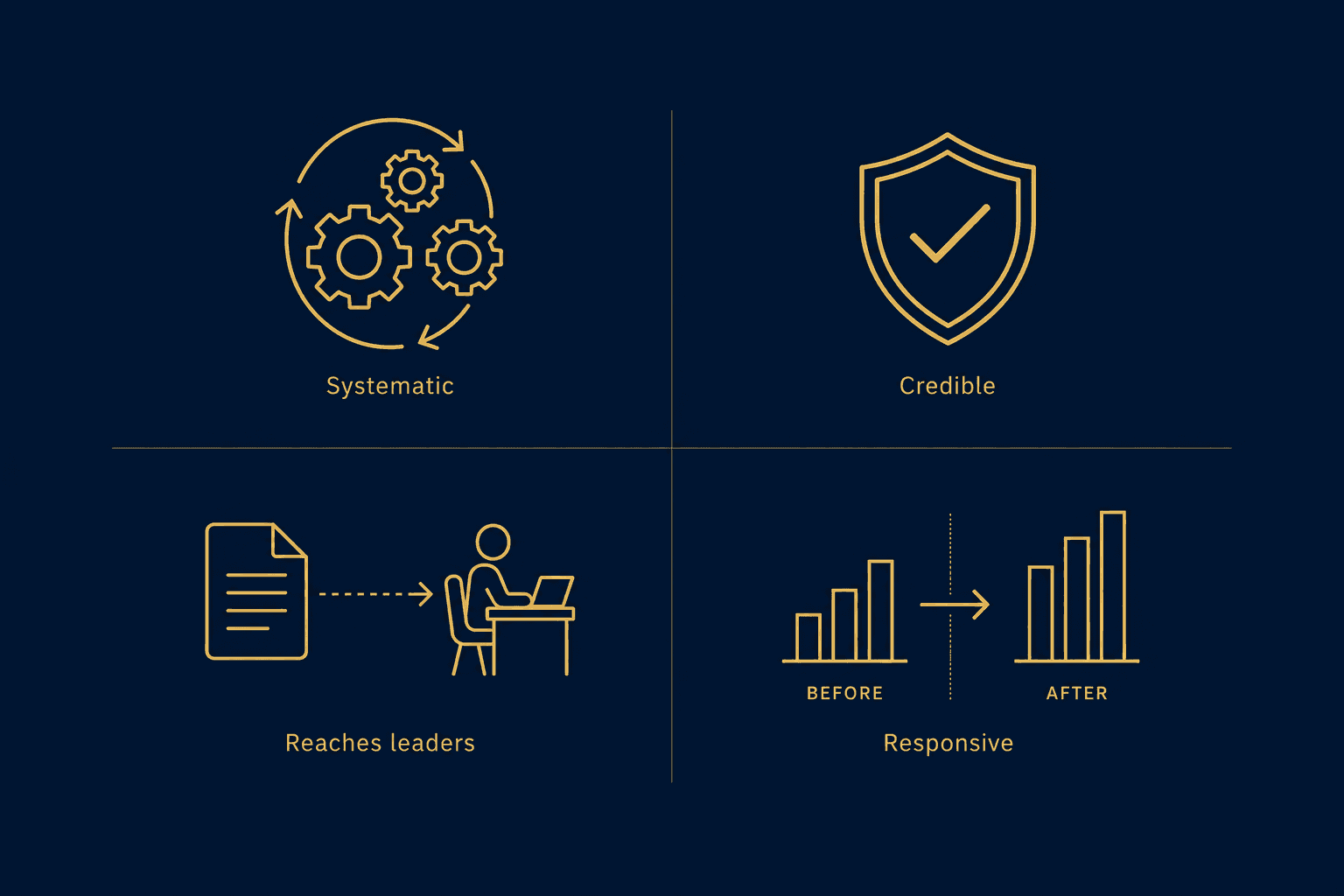
Four questions sit behind every community-feedback standard. An annual survey struggles to answer any of them well.
An annual consultant survey struggles on all four. It is periodic rather than systematic. Its response rates are usually thin. It measures general sentiment rather than the actual service your officers delivered on a given day. And by the time the results are formatted and delivered, the data is far too stale to drive a decision, let alone to demonstrate a feedback loop that closed. It clears the checkbox and almost nothing else.
It is worth adding that this is no longer only a CALEA question. A majority of states now run their own accreditation programs, and many of them lifted their community-engagement language more or less directly from the national standards and the 21st Century Policing framework. So even agencies that never pursue national accreditation increasingly sit across the table from a state assessor asking the same four questions. The direction of travel is unmistakable, and it points squarely at continuous, documented community input.
The continuous-evidence alternative
Now picture the same evidence file for an agency that collects verified, interaction-level community feedback all year long.
Every routine encounter, a traffic stop, a call for service, a community contact, ends with the officer handing over a single-use, QR-coded interaction card. The community member completes an anonymous survey in about a minute, scoring the interaction on the five procedural justice behaviors that research ties to trust: explaining the why, listening, fairness, professionalism, and clear next steps. Roughly two-thirds add a written comment in their own words.
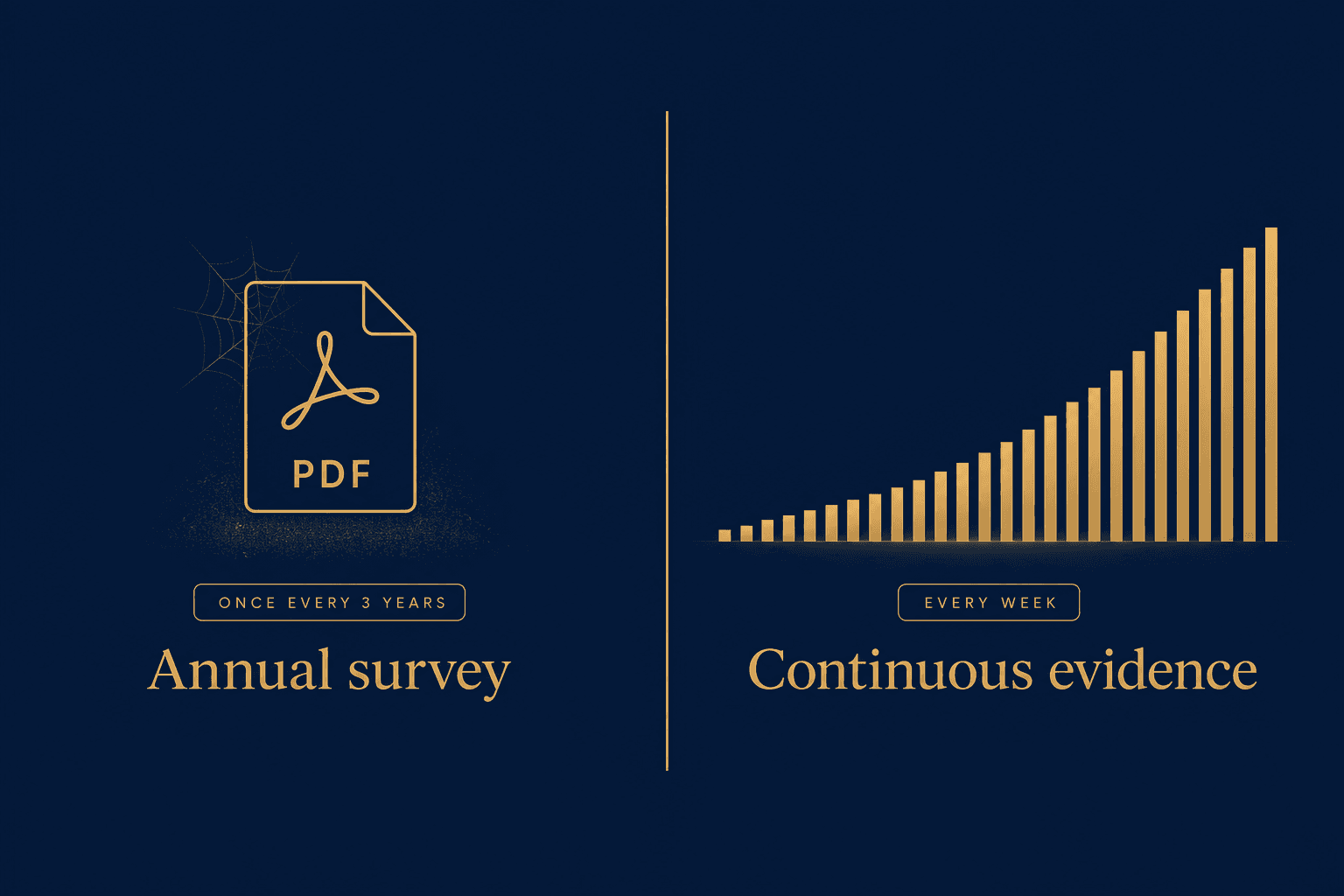
The difference is not the survey. It is the cadence. A stale document versus an evidence file that grows every week.
For the accreditation file, that cadence changes everything.
- Systematic, by construction. Collection is embedded in daily operations, not scheduled around the assessment calendar. The file grows every single week without anyone launching a project.
- Credible, by design. Each response is tied to a verified interaction, which closes the door on open-form brigading. It carries no PII, which simplifies your FOIA posture. And it is available in 26+ languages, which speaks directly to standards about serving diverse communities.
- Demonstrably reviewed. Scheduled weekly reports to command staff, dashboards worked through in CompStat-style meetings, coaching conversations documented against a trend. Each of those is an exhibit showing feedback reaching the people who make decisions.
- A closed loop you can prove. When listening scores in one district slip, the agency runs refresher training, and scores recover the next quarter, you have the exact responsiveness narrative assessors describe as best practice, with the data to back every step.
The reframe worth internalizing is this. Accreditation is not the reason to measure community feedback. It is one of a half-dozen dividends of measuring it, alongside early intervention, officer recognition, and ongoing trust measurement, that happens to arrive with an assessor's signature attached.
What a closed loop looks like on paper
Assessors respond to specifics, so give them one. Picture your month-four dashboard showing the "explained the why" score in the north district sitting a full point below the rest of the agency, with the written comments clustering around traffic stops. That is a finding. Your response is a fifteen-minute roll-call module on narrating the reason for a stop, delivered to north district shifts over two weeks, plus a direct note to the affected sergeants. That is an action. By month seven the north district score has closed most of the gap and the comment sentiment has visibly shifted. That is the result.
Written up as three short paragraphs with the two charts attached, that single loop answers the hardest question buried in the standard: did community input actually change how this agency operates. It is more persuasive than any survey PDF, because it is not a snapshot of opinion frozen in a quarter. It is a record of the agency listening, acting, and then checking its own work. Assemble three or four of those over a self-assessment year and the community-feedback file stops being merely defensible and starts being the thing you want the assessor to open first.
A practical timeline for accreditation-driven adoption
Agencies pursuing initial accreditation, or entering a reaccreditation cycle, can stand this up comfortably inside a single self-assessment year. The phases are simpler than most software rollouts because there is almost no software to roll out.
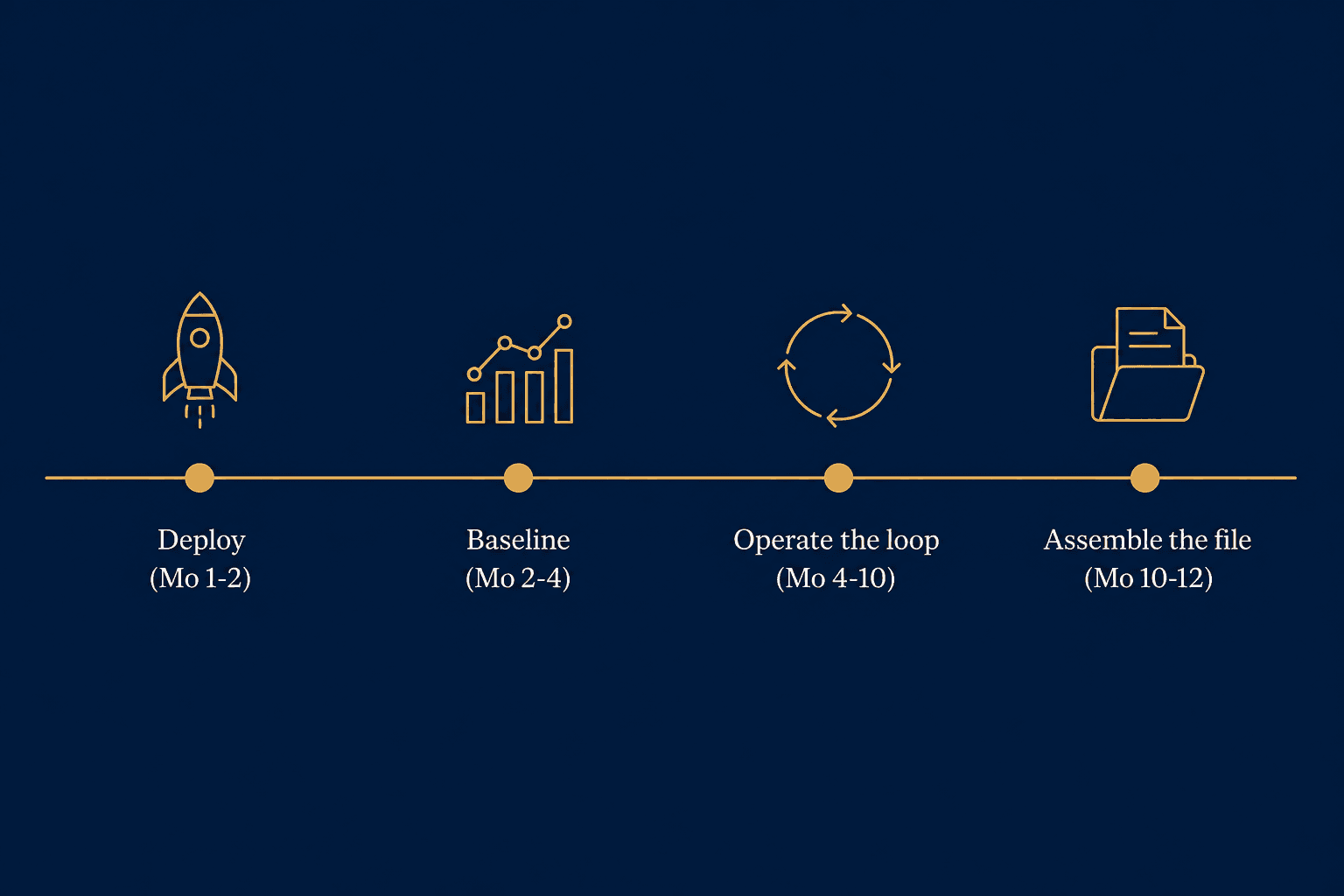
One self-assessment year, four phases. By month twelve the community-feedback file is the strongest exhibit in the binder.
Months 1 to 2, deploy. Roster setup, card printing, an officer briefing. Because a modern feedback platform is standalone SaaS, a browser and email with no CAD or RMS integration, IT involvement is minimal and procurement is simpler than most software purchases. Many agencies scope this as a 60 to 120 day pilot first, which lowers the barrier to a yes.
Months 2 to 4, build baseline volume. Soft launch with one or two units, then go department-wide. Targets that hold up in practice: first surveys within two weeks, steady weekly volume by month three. Start the scheduled weekly report to command staff on day one. The review cadence itself is evidence, so begin generating it immediately.
Months 4 to 10, operate the loop. Review the trends every quarter. Document at least one instance where the data drove an action: a training emphasis, a supervisory conversation, a policy tweak, a public communication. Capture the before-and-after metrics so the loop is not just described but shown.
Months 10 to 12, assemble the file. Export the year of reporting: survey volumes, response trends, procedural justice scores by period, the documented feedback-to-action examples, and public-facing transparency artifacts. A public department page displaying community ratings is a powerful exhibit for community-relations standards, and it doubles as reputation insurance long after the assessor leaves.
By assessment time, the community-feedback file is no longer the weak spot in your binder. It is the exhibit the assessor mentions in the exit interview.
Objections your accreditation manager will hear
"Won't anonymous feedback create a FOIA problem?" Generally the opposite. Because respondents provide no personally identifiable information and results are analyzed in aggregate, there is no PII to disclose. Anonymized-by-design collection with role-based access controls is a cleaner records posture than a drawer full of signed complaint forms.
"Will the union object?" Unions object to systems built to punish. A recognition-first system tends to earn adoption rather than grievances, because the large majority of feedback is positive, officers can see their own scores and comments, and negative trends trigger coaching rather than discipline. Lead the briefing with the recognition data, and the conversation changes tone quickly.
"We do not have the staff to run a survey program." There is nothing to run. Officers hand out cards, the community responds on their own phones, and reports arrive on schedule. The administrative footprint is roster maintenance, self-service and measured in minutes per week, not a new full-time responsibility on an already stretched command staff.
"We just paid a consultant last cycle." Then you already know the ceiling of what a periodic survey buys, and roughly what it costs. Continuous measurement tends to land in the same budget neighborhood as a single serious consultant engagement, except it runs every week instead of once, and the output is an operating tool rather than a document that goes in a drawer. If the line item already exists, this is a reallocation rather than a new ask, which is usually the easiest budget conversation a chief gets to have.
Beyond the checkbox
Accreditation exists to institutionalize professional standards. The agencies that treat the community-feedback standard as a checkbox will keep buying a PDF every three years and calling it engagement. The agencies that treat it as an invitation will end up with something far more valuable: a continuous, credible, hard-to-argue-with answer to the question every chief eventually faces in a council chamber. How do we know your department treats people well?
That answer is worth building for its own sake. The assessor's signature is just the first place it pays off.
Guardian Score gives agencies verified, anonymous, interaction-level community feedback with scheduled reporting built for accreditation evidence, live in weeks with no IT integration. Talk to us about mapping the platform to your accreditation cycle.
Frequently asked questions
Does CALEA require community surveys?
CALEA standards require agencies to survey community attitudes and document how that feedback informs operations, and many state accreditation programs mirror the same expectation. The trend across accreditation bodies has been toward stronger, more continuous community-input requirements, not weaker ones.
What community feedback evidence do accreditation assessors want to see?
Four things: systematic collection rather than a once-per-cycle survey, a credible methodology a council member or journalist could not easily dismiss, proof that results are reviewed by command staff, and documented examples where feedback led to a training, policy, or supervision change.
Can anonymous community feedback create FOIA problems?
Generally the opposite. Because respondents provide no personally identifiable information and results are analyzed in aggregate, there is no PII to disclose. Anonymized-by-design collection with role-based access is a cleaner records posture than a binder of signed complaint forms.
How long does it take to build an accreditation-ready feedback file?
One self-assessment year is comfortable. Most agencies deploy in the first two months, reach steady weekly volume by month three, run a documented feedback-to-action loop through the middle of the year, and assemble the exhibit in the final quarter.