

American policing is living through two crises at once. Ask a chief about the first and you will hear about vacancies: academies half full, veterans leaving early, whole units quietly folded to keep patrol staffed. Ask about the second and you will hear about trust: strained relationships, viral incidents, the exhausting work of being judged by the worst moment of someone else's shift.
Here is the uncomfortable finding buried in the recruitment data. They are not two crises. They are one loop.
The numbers behind the loop
In IACP's national survey on recruitment and retention, more than 70 percent of agencies said recruiting has become harder than it was five years ago. Departments are operating at roughly 91 percent of authorized strength on average, and about 65 percent report cutting services or disbanding units to cover the gap.
But the number that should stop every command staff meeting is this one. 78 percent of agencies cite negative public perception as a top barrier to recruitment.
Not pay. Not the labor market. Perception. The way policing feels to the public, and to the young people who might have joined, is now the profession's biggest recruiting competitor.
Sit with what that means. An agency can raise salaries, streamline hiring, and modernize its academy, and still lose the recruiting battle to a variable it has never measured and does not manage. Perception gets treated like weather, something that happens to the department from the outside. It is not weather. It is the accumulated residue of encounters, and encounters are the one thing a department fully controls.
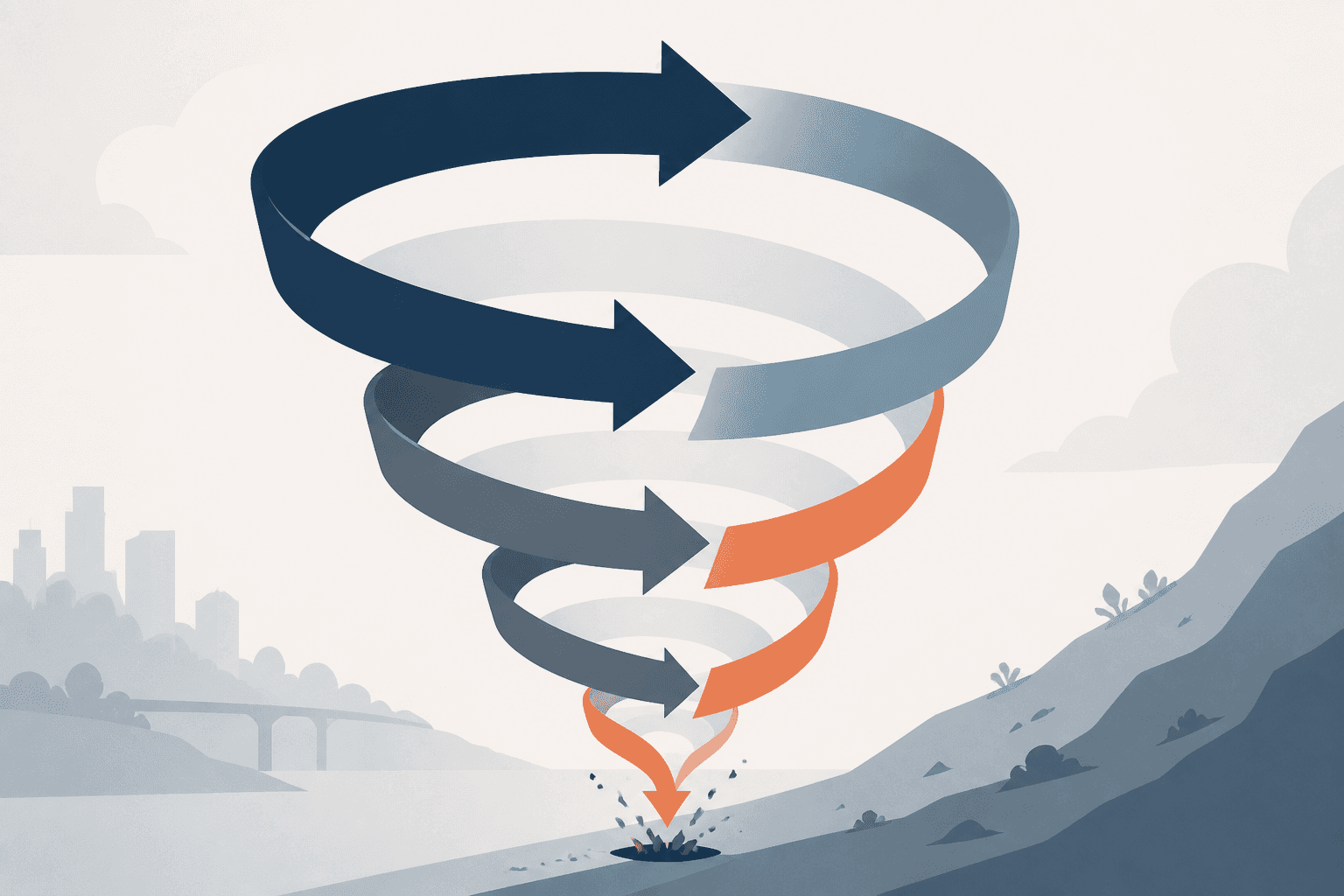
The trust-recruitment death spiral: four stages that feed each other, and turn faster as burnout pushes good officers out.
How the spiral turns
The mechanics are brutally simple.
- Low trust drives negative perception. Every viral incident anywhere becomes local perception everywhere.
- Negative perception shrinks the applicant pool. Who signs up for a profession they believe their own neighbors resent?
- Understaffing degrades service. Longer response times, fewer community events, officers running call to call with no time for the human moments.
- Degraded service lowers trust. And the wheel turns again, faster this time, because now your best officers are burning out and leaving too.
The cruelest part is the acceleration. Each turn of the loop removes a little more of the capacity you would need to break it. The community events that build goodwill are the first thing cut when patrol is short. The veteran officers who model calm, fair encounters are the ones with the most options to leave. So the spiral does not just repeat, it compounds, and an agency can find itself working harder every year for a worse result.
Every agency knows this loop from the inside. What gets less attention is why it is so hard to break. The profession's entire feedback system is wired to make it worse.
The hidden cost of the spiral
There is a financial version of this story that budget directors feel even when they cannot quite name it. Every officer who leaves early walks out with a large, sunk investment. Recruiting, background checks, the academy, months of field training, and the years it takes to turn a new hire into a seasoned officer who actually knows the neighborhood. When attrition climbs, agencies backfill the gap with overtime, which burns out the officers who stayed and nudges the next round of them toward the exit.
So the spiral is not only a trust problem and a staffing problem. It is a compounding cost that surfaces as swollen overtime lines, growing training budgets, and consultant contracts for recruiting campaigns that fight the symptom instead of the cause. None of that spending touches the variable that started the loop. You can pour money into the top of the funnel forever, but if perception keeps shrinking the pool while burnout keeps widening the exit, you are bailing water without patching the hull.
The only feedback is negative
Think about the feedback an officer can actually receive over a typical career. A complaint. An internal affairs investigation. A lawsuit. A headline. A body camera review, usually triggered by something going wrong.
Meanwhile the overwhelming majority of what officers do generates no signal at all. The driver who calmed down because the officer explained the stop. The stranded family who got home. The welfare check handled with patience at 3 a.m. In most departments an officer's finest professional moments are invisible to their supervisors, to their evaluation, and eventually to their own sense of the job.
Now connect that to retention. We ask officers to stay in a profession where the public narrative is hostile, the internal feedback is complaint-driven, and excellence is structurally unseeable. This is the same asymmetry we dig into in officer recognition and retention: the systems only speak up when something breaks. The surprise is not that officers are leaving. The surprise is how many of them stay.

The feedback an officer can receive is heavily weighted toward what went wrong. Most careers offer almost no structured channel for what went right.
Why the usual fixes stall
Most agencies answer the recruiting crisis with the levers they can pull quickly: signing bonuses, faster hiring timelines, slicker recruitment videos, a bigger presence on social media. Those are reasonable moves, and a few of them help at the margins. But they all treat recruiting as a marketing funnel, when the real constraint sits upstream in how the profession is experienced and how it is perceived.
A bonus can get someone to apply. It cannot convince a community that its officers are fair, and it cannot show a wavering recruit's family that the work is respected. Marketing can amplify a message, but it cannot manufacture one that the underlying reality keeps contradicting. If the day-to-day experience of your community is not improving, even the most honest recruiting campaign eventually reads as spin. The only durable fix is to change the thing the campaign is trying to describe.
What breaking the loop looks like
You cannot tweet your way out of a perception problem, and recruiting campaigns cannot outrun the underlying signal. Breaking the spiral means changing what the system measures, because what it measures is what officers experience, and what officers experience is what the community eventually feels.
Measure the encounters, not just the incidents. Roughly 60 million police-community interactions happen in the United States every year. Almost none are measured. Every one of them is a data point about trust that currently evaporates. Agencies that capture even a fraction of that signal, using a practical framework like the one in our guide to measuring community trust, suddenly hold something no press release can provide. Evidence.
Let recognition outnumber complaints. When community members rate real encounters on fairness, listening, and respect, the results shock most command staffs. Scores average around 4.7 out of 5, and about two-thirds of respondents write a comment, most of them some version of thank you, tell him thank you. For many officers it is the first structured positive feedback of their entire careers. That is not a nice-to-have. That is a retention intervention.
Show, do not tell. A chief holding real trust data can answer the council, the journalist, and the recruit's mother with the same sentence. Here is what our community actually says about our officers, encounter by encounter. Front Royal's chief, Kahle Magalis, put it plainly. "This gives me a way to prove our officers do a good job."
Put those three moves together and the loop starts running in reverse. Measured encounters give the agency real evidence. Evidence lets recognition finally outnumber complaints. Officers who feel seen stay longer and treat people with more patience, which the community feels and eventually repeats to the next person weighing whether to apply. The same wheel that dragged the agency down can carry it back up. It just has to be pointed the other way, and it only turns once you are willing to measure it.
"We thought it would bring more negative feedback"
The objection every chief hears from the ranks is predictable. Will this just be another complaint pipeline?
It is worth listening to Officer Molly Kimball, a patrol officer in Warrenton, Virginia, who was there when her department started handing out feedback cards.
At first we were skeptical. We thought it might bring more negative feedback. After using it, a lot of us really like it. It's been a positive experience for me and my colleagues.
That arc, from skepticism to advocacy, repeats because the fear is based on the internet and the reality is based on encounters. Anonymous strangers rating "the police" produce rage. Real people rating the actual officer who just helped them produce gratitude, specifics, and the occasional hard truth an officer can genuinely use.
What to do Monday
- Put a number on it. Ask your command staff what your agency's community trust score is, then sit with the silence.
- Audit your feedback asymmetry. Count the channels a complaint can travel versus the channels a compliment can. Most agencies find a ratio of about five to zero.
- Pilot measurement where trust is actually built: traffic stops and calls for service, not just the annual survey.
- Recognize in public and coach in private, and let your officers see the 4.7 before anyone lectures them about accountability.
The recruitment crisis will not be solved by better slogans, bigger bonuses, or lowered standards. It will be solved by making the profession feel like what it actually is on most calls: skilled, fair, human work, witnessed and measured and finally recognized. That, at bottom, is the guardian mindset turned toward the profession's own people.
Trust is recoverable. But only the agencies that measure it will know when they have earned it back.
Guardian Score turns everyday encounters into verified, anonymous community feedback: recognition-first, officer-level, live in days. If you want to see why skeptical officers become its biggest advocates, book a 20-minute demo.
Frequently asked questions
Why is police recruitment so hard right now?
In IACP's national survey, more than 70 percent of agencies said recruiting is harder than it was five years ago, and 78 percent cite negative public perception as a top barrier, ahead of both pay and the labor market.
How does community trust affect police recruitment?
They form a loop. Low trust drives negative perception, perception shrinks the applicant pool, understaffing degrades service, and degraded service lowers trust again. Breaking it means changing what the profession measures.
Will community feedback just produce more complaints?
The opposite tends to happen. Verified ratings of real encounters average around 4.7 out of 5, and about two-thirds of respondents leave written comments, most of them appreciative. Officers who start out skeptical often become the strongest advocates.