
Walk into almost any police academy in the country and you will hear the word guardian. It is in the mission statement, the graduation speech, and the poster above the roll-call room. Ask the chief a harder question, though, and the confidence tends to drain out of the room. Is your department actually policing like guardians on the street this week? The honest answer, almost everywhere, is some version of "we think so."
That gap, between the philosophy departments preach and the behavior they can prove, is the subject of this article.
The idea itself is now part of the furniture of American policing. Scholars like Seth Stoughton framed the split, and the President's Task Force on 21st Century Policing put it at the center of national reform. A warrior culture teaches officers to read every encounter as a threat to be controlled. A guardian culture teaches them to see themselves as protectors of the community, including the people they stop, question, and arrest. Most leaders accepted the premise years ago. Curricula were rewritten. De-escalation and procedural justice became standard. The argument, as an argument, is finished.
What is not finished is the execution.
What a guardian mindset actually looks like
The warrior and guardian labels are not about tactics or officer safety. Guardians go home at the end of their shift too, and no serious version of this framework asks anyone to absorb more risk. The distinction lives in the default posture an officer brings to the roughly ninety-eight percent of contacts that involve no threat and no force.
That posture is not abstract. It is visible in a handful of behaviors that anyone on the receiving end can describe:
- Does the officer explain why the stop is happening, or treat the question itself as a challenge?
- Does the officer listen before deciding, or decide before listening?
- Is enforcement proportionate and consistent, or shaped by who pushed back?
- Is the tone that of a professional providing a service, or an authority occupying a block?
- Does the encounter end with clarity about what happens next?
Anyone who has studied procedural justice will recognize the list. These are its measurable components, and this is the link most culture programs miss. "Guardian mindset" sounds like a value, something you either hold or you do not. Its fingerprint, though, is concrete behavior, and the people best positioned to observe that behavior are the community members standing inside the encounter.
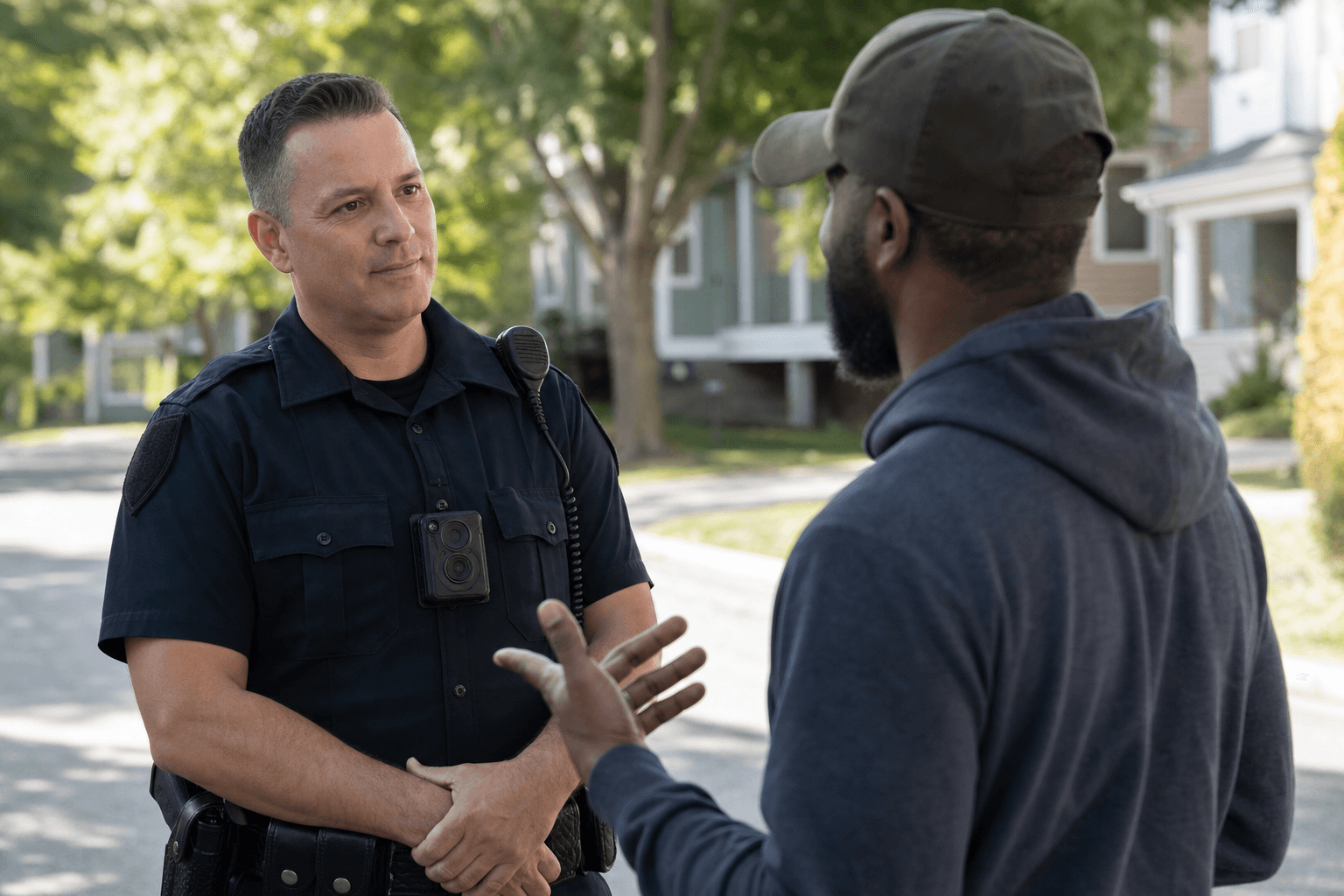
The guardian posture is legible to the person across from the officer: explaining, listening, and treating the contact as a service rather than a confrontation.
Why training wears off
Departments have spent real money on guardian-oriented training, and the research, including Stanford SPARQ's work on principled policing, shows good training can move attitudes. Every chief also knows the failure mode. The training high fades, the veteran culture reasserts itself, and a year later nothing observable has changed.
The reason is structural, and it is the same in a police department as in any organization. Culture follows what gets measured and recognized, not what gets said in a classroom.
Look at what a typical department's numbers actually reward. Arrests, citations, response times, clearance rates. Every one of them is a warrior-compatible output. An officer can spend an entire shift defusing conflict, reassuring victims, and treating every person with dignity, and produce nothing the performance system can see. The stats that do get counted say nothing about how anyone was treated. Officers are rational people; they play to the scoreboard they are handed. If the scoreboard only counts enforcement, the guardian training was a speech with a good slideshow.
A real culture shift, then, has to change the scoreboard. It has to measure how officers police alongside how much.
Turning philosophy into data
Here is what the measurable version looks like in practice, and it is less exotic than it sounds.
Start by instrumenting the ordinary encounter. After routine interactions, officers hand a person a single-use, QR-coded interaction card. The anonymous survey takes about a minute and scores the encounter on the same guardian behaviors listed above. One card ties to one real contact, which keeps the data honest, and anonymity keeps it safe to be candid.
Then report it the way you already report crime. Guardian behavior belongs in the command-staff meeting next to the crime stats, a CompStat for trust. Squad-level comparisons, month-over-month trends, and outliers turn the vague question "are we guardians?" into an operational one: which units are climbing, and what are they doing right? Real-time analytics at the officer, squad, and department level exist for exactly that conversation.
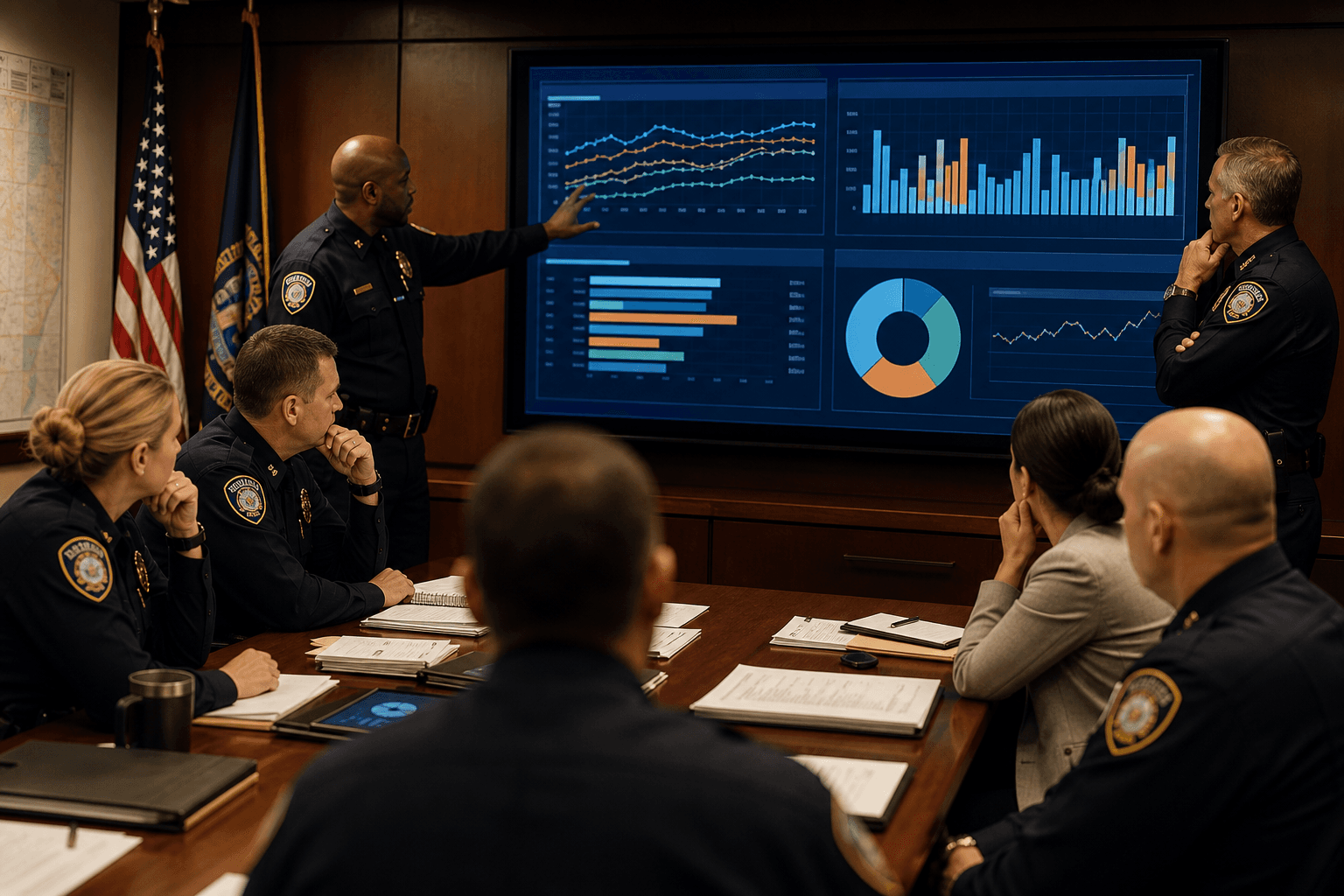
A CompStat for trust: guardian behavior moves from a value on the wall to a line on the command-staff agenda, tracked by squad and over time.
Recognition is the part leaders underestimate. When roughly two-thirds of respondents leave a written comment, supervisors end up with an endless supply of authentic material: the officer thanked for calming a frightened parent, the traffic stop that ended with respect on both sides. Reading those in roll call, with the officer's name attached, does more for culture than any laminated value statement. It tells officers the department sees guardian behavior, and that the community sees it too.
Finally, coach the gaps in private. The same data that celebrates a strong squad also surfaces drift: an officer whose listening scores are sliding, a unit whose fairness ratings trail the rest. Handled as quiet, trend-based coaching rather than discipline, that closes the loop training leaves open. Skills get taught, then measured, then reinforced.
The objections every chief will hear
"This is soft-on-crime metrics." It is not. Nothing about measuring treatment quality reduces enforcement. Officers make the same stops and the same arrests; the data captures how. Departments routinely find that even people who were cited or arrested rate their officers well when they were treated fairly, which is evidence no chief has ever been able to carry into a council meeting before.
"Officers will call it surveillance." They will, if you deploy it as surveillance. Led with recognition, where most of the feedback is positive and lands directly with the officer, it becomes the opposite: often the first system in a career that documents an officer's good work. Plenty of officers check their scores the way they check a fantasy football lineup.
"Culture cannot be reduced to a number." Correct, and beside the point. The number is not the culture. It is the feedback loop that keeps the culture alive. No chief thinks crime is reduced to a UCR figure, and no chief would try to run a department without one.
The chiefs who own the next decade
The guardian and warrior debate is settled as philosophy. The competition now is operational: which departments can make the guardian mindset something they train, measure, recognize, and report, and which will keep it as a line in a speech.
The leaders in the first group walk into the council chamber holding something genuinely new: verified evidence, from their own residents, of how their officers treat people. That is what measurable trust looks like, and it is the strongest legitimacy argument in modern policing.
Guardian Score turns guardian philosophy into guardian data: verified community feedback scored on procedural justice behaviors, with recognition and coaching built in. Book a demo to see how departments make the shift measurable.
Frequently asked questions
What is the difference between the warrior and guardian mindset in policing?
A warrior culture trains officers to treat every encounter as a threat to be controlled. A guardian culture trains officers to see themselves as protectors of the community, emphasizing communication, fairness, and de-escalation in the vast majority of contacts that involve no threat at all.
Can the guardian mindset actually be measured?
Yes. Its behavioral fingerprint of explaining why, listening, treating people fairly, staying professional, and explaining next steps can be rated by community members after verified interactions, producing officer-level and squad-level culture data.
Does measuring how officers treat people reduce enforcement?
No. Officers still make the same stops and arrests. The data captures how those actions are carried out, and departments consistently find that even people who receive citations rate their officers well when they were treated fairly.