
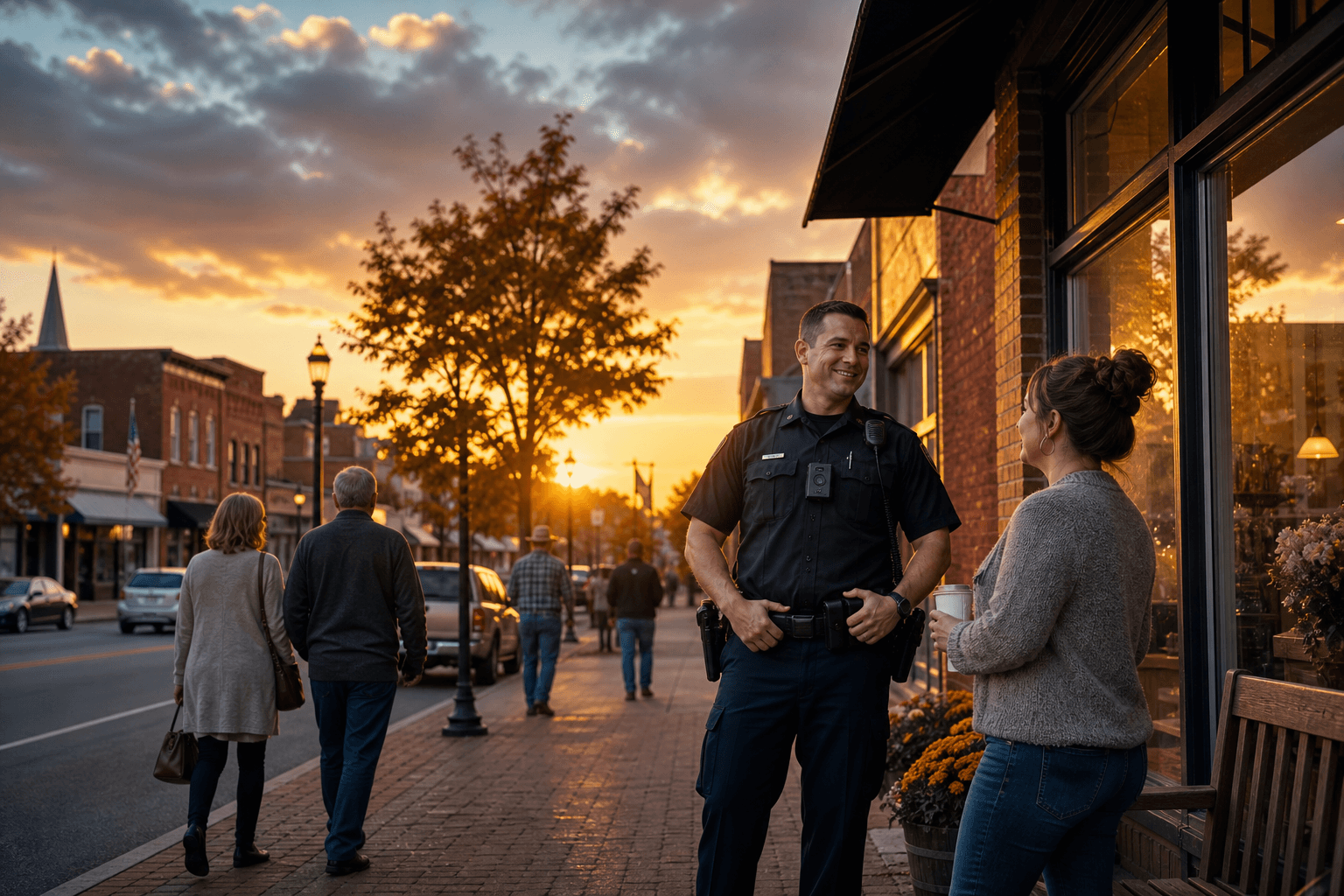
When community trust measurement comes up at a conference, the case studies are almost always big. A metro department with a research partnership, a data analyst on staff, and a line item that would cover a small agency's entire fleet. If you lead a department of ten or twenty officers, the honest reaction is the same one I hear over and over: good for them, not for us. That program was built for a world you do not work in.
Here is what gets lost in those keynote slides. According to the Bureau of Justice Statistics, the United States has roughly 18,000 law enforcement agencies, and most of them have fewer than 50 officers. Small is not the exception in American policing. Small is American policing. If trust measurement only works at metro scale, then it does not really work for the profession, it works for the handful of departments that get the conference invitations. The good news is that it does not only work at metro scale. In several ways that matter, it works better in a small agency than a large one.
Why small police departments think community feedback is out of reach
The objections are consistent from chief to chief, and each one deserves a straight answer instead of a sales pitch.
"We can't afford it." Big-city programs are expensive because they are built around consultants, custom survey instruments, and staff analysts. A modern per-interaction feedback program is priced on a completely different model. Flexible plans exist for every department size, and grant assistance is available to agencies that need help finding the money. For a lot of small departments, the annual cost lands somewhere near what you already spend sending two officers to a single out-of-state conference.
"We don't have IT staff." You do not need any, and this is the objection I most want to put to rest. A card-and-dashboard model requires no CAD or RMS integration and no software to install on anything. Guardian Score designs, prints, and delivers the interaction cards; officers hand them out; results show up in a web dashboard. The entire technical footprint is a browser and an email address. If your department can check email, it can run this.
"We don't have the survey volume to make the data mean anything." This one is half right, and I will not pretend otherwise. A ten-officer agency will never generate metro-scale numbers, and anybody who tells you a single week of data proves something is selling too hard. But trends over months absolutely mean something, and small agencies carry an advantage that offsets the volume gap entirely: context. When the chief personally knows every officer, a shift in one officer's scores is immediately interpretable in a way no big-city dashboard can match. You are not staring at an anonymous data point. You know exactly whose month that was.
"Our community already knows us." Familiarity is real in a small town, and so is the grapevine. But the grapevine is not documentation. When a council member, a grant reviewer, or an accreditation assessor asks for evidence of community trust, "everyone knows us" does not export to a spreadsheet. Verified feedback does, and it satisfies the same expectations behind CALEA-style citizen-attitude requirements that a friendly reputation never will.
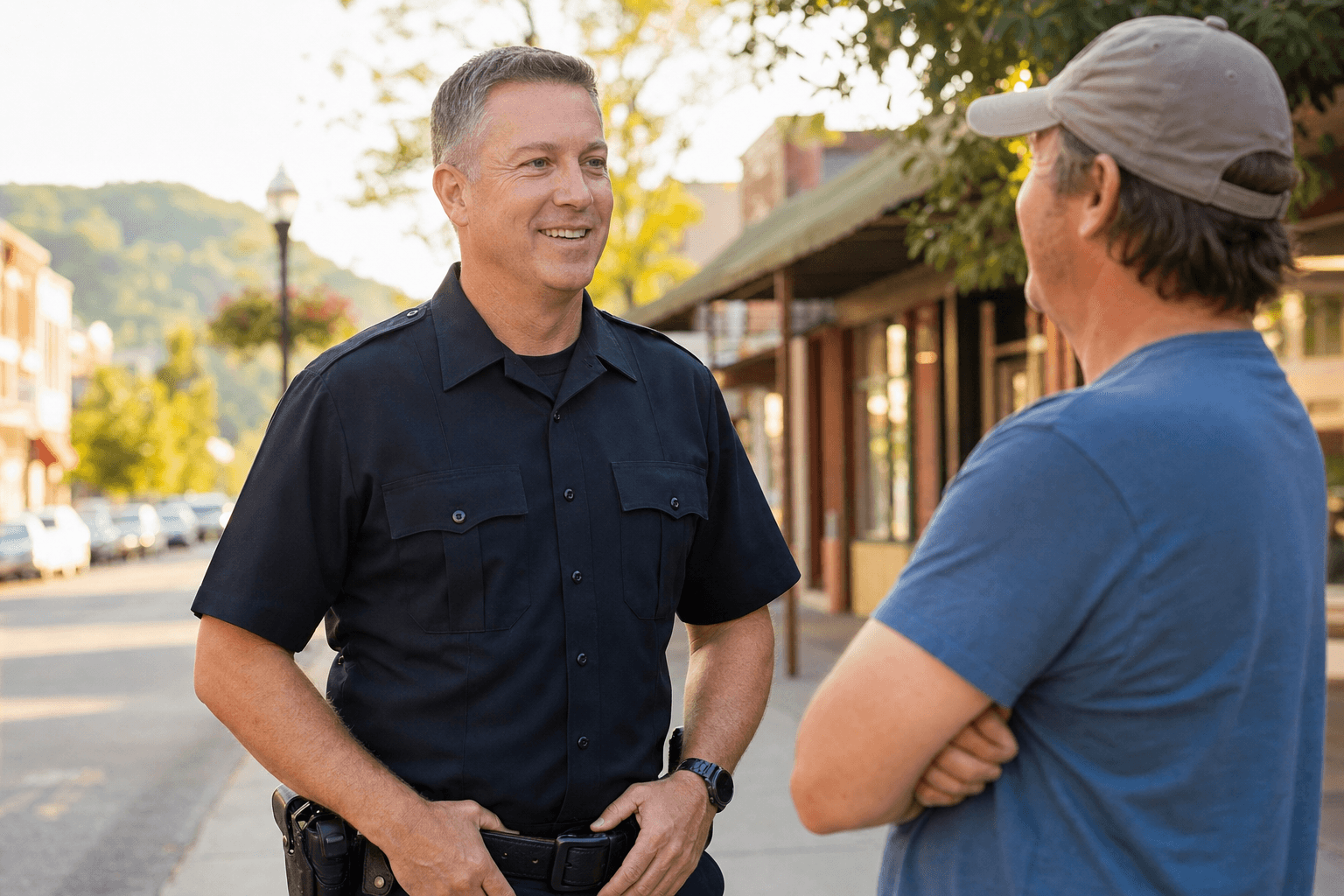
In a small agency, officer-level feedback is not a data point in a bureaucracy. It is a conversation the chief can have the same afternoon.
The small-agency advantage
Now flip the whole frame. Instead of asking what a small department lacks, ask what a 15-officer agency has that a 1,500-officer agency would pay dearly to get back.
The chief knows every officer. In a metro agency, officer-level trust data feeds a bureaucracy: a flag, a form, a routing decision, a meeting three levels up. In a small agency, that same data feeds a conversation that can happen before the shift ends. A three-month dip in one officer's listening scores becomes coffee with the chief, not a formal early-intervention flag with a paper trail attached. You get to intervene while it is still a nudge.
The community is tight, and word travels. When residents discover they can rate their own encounters, anonymously and in about sixty seconds, the program itself becomes a trust signal. It says something out loud: this department asked to be graded, on purpose, and published what came back. Chief Nader Oweis of the Sonoma State Police Department describes exactly that dynamic. "We were trying to find another way to engage our community and get real-time feedback. Guardian Score has been a great success on campus." The act of asking is half the message.
Recruiting stakes are higher, and so is the payoff. IACP research finds that more than 70 percent of agencies say recruiting has gotten harder, and 78 percent point to negative public perception as a recruitment barrier. A small agency that can show a recruit documented community appreciation, real comments from real residents about real encounters, is offering something most departments of any size cannot. It also gives the officers you already have a concrete reason to stay, which is the quieter half of the crisis; our piece on recognition and retention digs into that side.
Every single interaction carries more weight. Across agencies using Guardian Score, the average rating is 4.7 out of 5 and roughly two-thirds of surveys include written comments. In a small town, those comments are not from strangers. They are from neighbors, from the parent at the ball field, from the person at the hardware store. That lands differently, for the officer who reads it and for the community that wrote it.
What small police department community feedback actually costs
Budget conversations go better with specifics, so here is the honest shape of the investment instead of a range designed to be vague.
The direct cost is a subscription scaled to department size. Plans are flexible precisely because a 10-officer agency and a 500-officer agency are not the same customer and should not pay like they are. There is no hardware to buy, no software to install, and no integration project to fund and staff. The cards are designed, printed, and delivered as part of the program, so there is no in-house production step either.
If the general fund cannot absorb it, grant assistance is available: Guardian Score helps agencies identify and apply for funding that fits community-engagement and trust-building work. Community feedback also happens to be the kind of line item that local partners, councils, foundations, and campus administrations tend to like funding, because the deliverable is visible and the reporting practically writes itself. A funder can see exactly what their money bought.
The indirect cost is officer time, and it rounds to zero. Handing a card to someone at the end of an encounter takes a few seconds. There are no forms, no data entry, and no follow-up expected from the officer. The survey happens on the resident's phone, on the resident's time.
A 10-officer rollout, week by week
Here is what a launch actually looks like at a small agency. No task force, no steering committee, no six-month planning phase.
Week 1, decide and set up. The chief briefs the department on three things: what the five survey behaviors are (explaining why, listening, fairness, professionalism, and explaining next steps), why the feedback is anonymous, and, most importantly, that early results will be shared with everyone rather than held over anyone's head. The roster goes into the system. Cards go to print. Total staff time: about an hour.
Week 2, cards arrive, soft start. Two or three officers who are naturally curious (there are always a couple) start handing cards out at the end of routine contacts: traffic stops, calls for service, walk-ins at the front desk. The goal this week is familiarity with the motion, not volume.
Weeks 3 and 4, everyone in. All ten officers are carrying cards now. The chief mentions it at briefing a couple of times a week to keep it front of mind. The first responses come in, and because the survey takes about a minute, completion runs high from the start.
Weeks 5 through 8, share the early wins. This is the step that turns skeptics, so do not skip it. Read two or three of the written comments aloud at briefing. Officers discover that the feedback is overwhelmingly appreciative, and something shifts. The program stops being the chief's project and starts being theirs.
Weeks 9 through 12, first real look at trends. With a full quarter of steady volume, the chief reviews officer-level and department-level trends. Not to grade anyone, but to establish the baseline that every future quarter gets measured against, and to pull the first quotable numbers for the next council packet.
A quarter in, a 10-officer department has something most agencies fifty times its size still do not: verified, longitudinal community-trust data, and a genuine story to tell about it. Not a survey that happened once and got filed, but a living measure the chief can point to on demand.
That is the part the conference case studies never quite say out loud. You do not need a metro budget or an analyst to measure trust. You need a method that respects how a small department actually runs, and the will to ask a question most agencies are still afraid to.
Guardian Score was built for the 18,000, not just the 18 biggest. Cards delivered to your door, dashboards live in weeks, and grant assistance if you need it. Get an instant quote sized to your department, or book a demo to see a small-agency rollout up close.
Frequently asked questions
How can a small police department collect community feedback?
The lowest-lift method is per-interaction feedback: officers hand a single-use QR card to community members at the end of an encounter, and residents complete a short anonymous survey. It requires no IT integration, no analyst, and no added officer paperwork.
How much does a community feedback program cost for a small agency?
Programs scale with department size, with flexible plans for small agencies and no hardware, installation, or integration costs. For many small departments the annual cost is comparable to a single conference trip, and grant assistance is available for agencies that need help covering the subscription.
Is officer-level feedback data meaningful in a department of 10 officers?
Yes, with patience. Single ratings mean little anywhere, but multi-month trends per officer are meaningful at any size, and a small-agency chief who knows every officer personally can interpret and act on those trends faster than any large department.
Do small departments need to measure community trust for accreditation?
Accreditation programs increasingly expect documented community input. CALEA, for example, requires a citizen-attitude survey at least every two years, and continuous verified feedback gives small agencies stronger, more current evidence than a single one-time survey.