Police training is asked to fix everything and almost never tested on whether it fixes anything. Agencies spend enormous sums on curricula whose effects on street-level behavior are simply unknown. That is why one study out of Chicago deserves every chief's attention. It took a one-day classroom course, followed thousands of officers for two years, and found measurable changes in the two outcomes departments care about most: use of force and complaints.
Here is the study the way a practitioner would want it: what the training was, what the researchers measured, what they found, where the evidence is limited, and what it implies for the difference between teaching fairness and measuring it.
The study
In 2020, researchers George Wood, Tom Tyler, and Andrew Papachristos published an evaluation of the Chicago Police Department's procedural justice training in the Proceedings of the National Academy of Sciences (PNAS). Tyler, a Yale professor, is the leading scholar of procedural justice, the framework holding that people judge police encounters less by the outcome they receive than by the fairness of the process: whether they had a voice, whether the officer was neutral, whether they were treated with respect, and whether the officer's motives seemed trustworthy.
Chicago rolled the training out to its workforce over several years, and the staggered schedule created a natural experiment. Because officers were trained at different times, researchers could compare trained and not-yet-trained officers over the same periods, following more than 8,000 trained officers.
What the training was
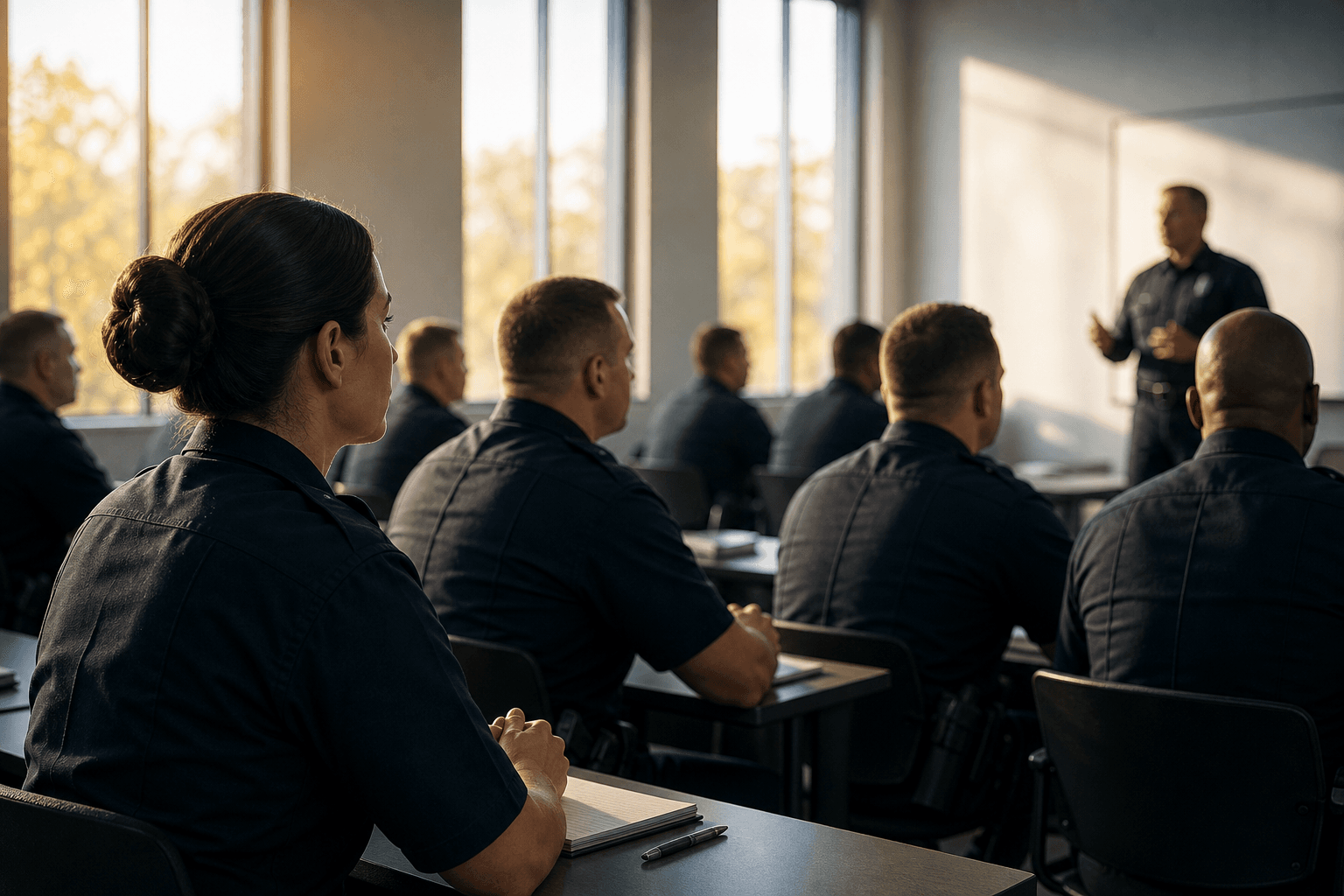
This was not a multi-week academy overhaul. It was a single day of classroom instruction built around the procedural justice framework: why fair process drives legitimacy, and how the principles of voice, neutrality, respect, and trustworthy motives translate into concrete behaviors during stops, calls, and arrests. Officers discussed scenarios, examined encounters from the community member's perspective, and connected the research to their own experience of being treated fairly or unfairly.
One day. That is the entire intervention being evaluated.

What the study measured
The researchers tracked administrative outcomes rather than survey responses: complaints filed against officers and use-of-force reports, before and after each officer's training date, across roughly two years. These are the records that drive lawsuits, discipline, and headlines, not self-reported attitudes, which training studies lean on and which frequently fail to translate into behavior.
What they found
Over the two years following training, the study found roughly a 10 percent decline in complaints against trained officers and a 6.4 percent decline in use of force, relative to what would have been expected without training.
Consider the scale. Chicago handles millions of police-community contacts. Across more than 8,000 trained officers, reductions of that size translate into hundreds of complaints that were never filed and hundreds of force incidents that never happened, from one day in a classroom. Few interventions in policing carry evidence of that strength at that little cost. For a fuller treatment of the framework, see our explainer on what procedural justice is and how to measure it.
The honest limitations
Practitioners deserve the caveats as clearly as the findings.
It is one city. Chicago is a large, heavily scrutinized department that trained under intense reform pressure. Effects elsewhere may be smaller, larger, or different, and replication is still accumulating.
It is observational, not a randomized trial. The staggered rollout is a strong design, but officers were not randomly assigned. Unmeasured differences in who got trained when could influence the estimates.
Administrative records are imperfect. Complaints undercount negative encounters, and force reports depend on reporting practices. Recorded outcomes are what departments manage, but they are not a complete picture of street behavior.
Decay is a real question. Training effects fade without reinforcement. A two-year follow-up is unusually long for this literature, but it cannot tell you what year five looks like.
None of this undermines the core finding. It bounds it: a single day of procedural justice training produced measurable, meaningful declines in force and complaints in one major department over two years.
Training tells, measurement shows
Here is the reasoning chiefs should sit with. If one day of instruction moves force and complaints by measurable amounts, then the binding constraint on procedural justice is not officer capability. Officers can do this. The constraint is reinforcement: nothing in most departments' daily operations tells an officer whether they are actually practicing what the training described.
Training tells officers what fairness looks like. Measurement tells them how they are doing.

That is the compounding move. The same four principles taught in the Chicago classroom can be rated by community members after real encounters: did the officer explain why, listen, act fairly, treat you with respect. Verified post-interaction surveys turn a one-day lesson into a continuous signal of officer-level trends and written comments from the people served. The decay problem inverts, because the feedback never stops arriving. And unlike a training certificate, measured community trust is evidence a chief can show a council, a community board, or an accreditation assessor.
There is a morale dividend, too. Complaints and force reports only capture what goes wrong. Continuous feedback captures what goes right, which is most of what officers do, and departments that measure it directly consistently find community ratings far more positive than officers expect.
Where this leaves a police leader
The evidence supports a two-part conclusion. First, procedural justice training is one of the best-attested, lowest-cost interventions available, and the Chicago study is the citation that justifies the training day. Second, training alone leaves the effect unmanaged. A department that teaches fairness once and never measures it is running an intervention with no gauge attached.
The study proved the behaviors are teachable. Whether they are sustained is a management question, and management runs on measurement.
Frequently asked questions
Does procedural justice training actually reduce use of force?
The strongest evidence comes from Chicago, where a one-day training was followed by a 6.4 percent decline in use of force and a 10 percent decline in complaints over two years, in a study published in PNAS in 2020. Effects in other agencies may differ, and replication is still accumulating.
What is procedural justice in policing?
It is the framework, led by Yale scholar Tom Tyler, holding that people judge police encounters more by the fairness of the process, meaning voice, neutrality, respect, and trustworthy motives, than by the outcome they receive.
How long does procedural justice training take?
The Chicago intervention evaluated in the PNAS study was a single day of classroom instruction. Sustaining the effect over time is a reinforcement question, which is where continuous measurement of the same behaviors comes in.