

Ask a patrol officer what actually gets counted at their department and you will get a fast, cynical, accurate answer: arrests, citations, response times, calls cleared. Then ask the same officer whether those numbers capture what they are genuinely good at, the things that keep a shift from going sideways. Talking a person in crisis back from the edge. Defusing a domestic before it becomes a report. Leaving a ticketed driver saying "thank you" instead of "I'll see you in court." You will get a shrug. Everyone in policing already knows the metrics measure what is easy to count, not what matters most.
This is not an argument against counting. It is an argument that the count is incomplete, and that the missing half has finally become measurable. So let me walk through where activity metrics came from, what they genuinely capture, what they structurally cannot see, and the balanced scorecard that a growing number of chiefs are building to close the gap.
A short history of police performance metrics
For most of the twentieth century, police performance metrics barely existed. Departments reported crime totals and little else, and an officer's value was mostly a matter of a supervisor's opinion. The professionalization era changed that. Response time became the flagship number of the radio-car age, a clean stopwatch measure that felt like science. Productivity measures followed: arrests, citations, and field contacts became the de facto proof of an individual officer's effort, the numbers you could put on a page at the end of a month.
Then the 1990s brought CompStat, and with it a real revolution. Crime data was mapped, updated weekly, and handed to commanders who had to stand up in a room and answer for their districts. It worked. CompStat proved something that should not be controversial: policing gets better when leaders manage against numbers and hold people accountable for them.

CompStat made crime measurable and manageable. It also quietly taught a generation of leaders that only enforcement output counts.
But CompStat also hard-wired a bias that has outlasted its inventors. Every metric in the system counted enforcement outputs or crime outcomes. Nothing in the stack asked the question communities actually judge their police on: how were people treated on the way to that number?
The policy world eventually said this out loud. The President's Task Force on 21st Century Policing recommended in 2015 that agencies "should track the level of trust in police by their communities just as they measure changes in crime" (Recommendation 1.7). Track trust like crime, with the same rigor and the same cadence. A decade later, most departments still run CompStat for crime and anecdotes for trust. One half of the job is instrumented to the minute. The other half is a feeling in the room.
What activity metrics capture, and what they miss
Fairness first, because these numbers deserve it. Arrests, citations, clearances, and response times are real information. They show effort. They flag workload imbalances between officers and between shifts. They connect to the outcome residents care about most after their own safety. No chief should throw them out, and no honest critique pretends they are worthless.
Now look at what they cannot see. The Bureau of Justice Statistics counts more than 60 million police-community contacts a year in the United States. The overwhelming majority produce no arrest and no citation, which means the overwhelming majority of policing is simply invisible to an activity-based scorecard. An officer who resolves a neighbor dispute so cleanly that nobody ever calls back generates nothing countable. An officer who escalates routine stops but writes plenty of paper looks, on the page, like the productive one. The scorecard is not neutral. It quietly rewards the wrong instincts.
It gets worse, because activity metrics can actively point in the wrong direction. A citation is a unit of enforcement, not a unit of quality, and the research is clear that quality is what builds legitimacy. Decades of procedural-justice studies find that people judge an encounter far less by its outcome than by whether the process felt fair. This evidence is not soft. A Chicago study of a single day of procedural-justice training (Wood, Tyler, and Papachristos, PNAS 2020) found that officers who went through it produced a 6.4 percent decline in use of force and a 10 percent decline in complaints over the following two years. Behaviors that never appear on an activity report moved the two numbers that keep every chief up at night.
So the gap is not philosophical or academic. Departments are managing one half of the job with precision and the other half with vibes, and then acting surprised when trust erodes in the space the metrics never looked at.
The balanced scorecard: police performance metrics for modern chiefs
The correction is not to swap crime metrics for trust metrics. That would be trading one blind spot for another. The correction is to run both, together, the way the Task Force actually intended. Picture two columns on a single scorecard.
The left column, crime and activity outcomes, stays exactly as it is: crime trends, clearance rates, response times, proactive work. It answers the first question a community asks, which is "are we safer?"
The right column, trust outcomes, gets added with equal weight and equal seriousness: verified community feedback tied to individual interactions, complaint and commendation trends, and procedural-justice behavior scores at the officer, squad, and department level. It answers the second question, the one that decides everything downstream: "does the community experience us as fair?" That is the question that determines whether residents call when something happens, cooperate with an investigation, testify in court, and vote yes on your budget.
For years the right column stayed empty for one honest reason: nobody had instrumentation for it. That is what has changed. Feedback tied to a real encounter, for example a single-use QR interaction card that an officer hands over at the end of a stop, linked to an anonymous 60-second survey, produces trust data with the same shape as crime data. It is timestamped, attributable to a unit, and trendable over time. Across agencies using Guardian Score, roughly 86 percent of started surveys are completed and about two-thirds include written comments, which is more than enough volume to run the trust column at CompStat cadence. Our cornerstone guide, how to measure community trust in policing, lays out the full framework for standing the column up.
One caveat, stated plainly because the method deserves an honest defense. Interaction-level feedback only reflects people who actually had police contact, and no single rating means much on its own. But that is exactly how the crime column already works. A single spike in burglaries is noise; a quarter-long upward trend is signal. The trust column runs on the same logic. You do not judge an officer on one survey any more than you judge a district on one bad week. You watch the trend.
It is worth being concrete about why the trust column earns its place on the page, because "it is the right thing to do" is not an argument that survives a budget hearing. Trust is operationally useful. Communities that experience their police as fair report crime more readily, cooperate with investigations more often, and are more willing to serve as witnesses when a case depends on one. Legitimacy is not a soft outcome that sits next to the real work; it is an input to clearance rates, to officer safety, and to the political capital a chief needs when something goes wrong and the department has to spend the goodwill it banked. A department that can show a rising trust trend has evidence for the budget conversation, evidence for the accreditation file, and evidence for the community meeting where someone stands up and says nothing has changed. The crime column has always been able to answer its critics with data. The trust column, filled in, finally lets a chief answer the other half of the room the same way.

A balanced scorecard does not replace the crime column. It fills in the trust column that has sat empty since CompStat.
Five trust behaviors you can measure at the officer level
"Measure trust" sounds hopelessly abstract right up until you break it into behaviors. Procedural-justice research reduces to five that a community member can recognize and rate in under a minute, and together they form an officer-level trust metric every bit as concrete as a clearance rate.
- Explaining why. Did the officer explain the reason for the stop or the contact?
- Listening. Did the person get a genuine chance to give their side of it?
- Fairness. Did the action taken feel proportionate and even-handed?
- Professionalism. Tone, language, and demeanor from the first word to the last.
- Explaining next steps. Did the encounter end with the person knowing what happens now?
These behaviors are ratable, coachable, and trainable. The Chicago results above came from teaching exactly this skill set, one day of it, and the effect held for two years. For a supervisor, five behavior scores trending over months tell you more about how an officer actually polices than any activity tally ever will. Sustained high scores become documented, defensible grounds for recognition instead of the vague "good officer" everyone nods along to. A sustained dip becomes a coaching conversation that happens well before a complaint or a lawsuit forces one, which is early intervention built on trust data rather than on red flags after the damage is done.
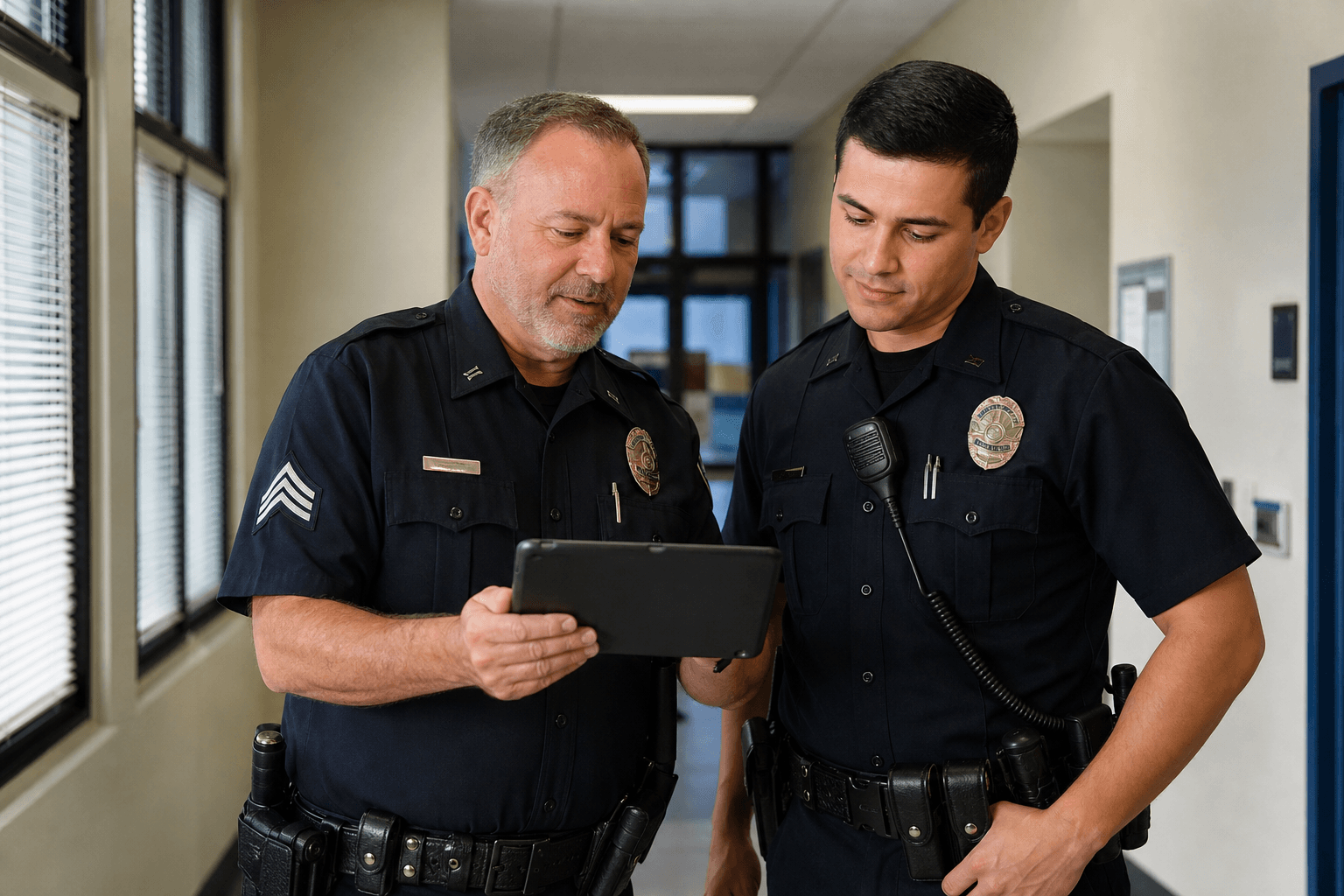
Five behavior scores trending over months give a supervisor something to coach on before a complaint ever forces the conversation.
At the command level, dashboards roll the same five behaviors up by squad and by department, so the trust column finally gets reviewed in the same meeting, with the same seriousness, as the crime column. That is the whole point. Not a softer version of accountability, but a more complete one. When both columns sit on the same page and get the same scrutiny, chiefs stop guessing about the half of the job that used to run on instinct.
The agencies that get ahead over the next few years will not be the ones that count more arrests. They will be the ones that finally started counting the 60 million contacts that never made the report, and managed the quality of those encounters the way they have managed crime for thirty years.
Guardian Score turns the five behaviors into live officer, squad, and department metrics, with no IT integration, cards delivered to your door, and dashboards live in weeks. Book a demo to see what a balanced scorecard looks like with the trust column filled in.
Frequently asked questions
What are police performance metrics?
Police performance metrics are the measures agencies use to evaluate officers and units. Traditional metrics track activity and crime outcomes such as arrests, citations, response times, and clearances. Modern balanced scorecards add trust outcomes such as verified community feedback and procedural-justice behavior scores, reviewed with the same rigor.
Why are arrests and citations not enough to measure police performance?
Because most police work produces neither. Of the more than 60 million police-community contacts in the U.S. each year, the large majority end without an arrest or citation, so activity metrics miss the quality of the everyday encounters that actually determine community trust and legitimacy.
What is a balanced scorecard in policing?
A balanced scorecard pairs crime and activity outcomes with trust outcomes, weighted equally: crime trends and response times alongside officer-level community feedback, procedural-justice behavior scores, and complaint and commendation trends, all reviewed at the same cadence.
How do you measure an individual officer's community trust?
By collecting verified, anonymous feedback after real encounters and scoring five procedural-justice behaviors: explaining why, listening, fairness, professionalism, and explaining next steps. Trends in those scores over months form an officer-level trust metric comparable in rigor to activity statistics.