

Most community-policing ideas do not die in the field. They die in the budget meeting. A chief walks in with a genuinely good plan to build trust with the community, and hears the sentence every chief has heard: there is no money for that this year. The DOJ COPS Office built a program specifically for that moment. It is called Community Policing Development, or CPD, and its microgrants track exists to fund exactly the kind of pilot that keeps getting cut. Most eligible agencies never apply for it.
This guide is for the chief who is tired of hearing no. It covers what COPS microgrants fund, who qualifies, what the award math actually looks like once you sit down with a calculator, and how to write an application that scores rather than gets set aside. It is meant to be useful whether or not you ever buy a thing from us. One caveat before you read further: grant amounts, categories, and deadlines change from cycle to cycle, so treat everything here as orientation and verify the current solicitation on the COPS Office grants page before you write a single sentence.
What CPD microgrants actually are
The COPS Office runs Community Policing Development to fund projects that build the capacity of law enforcement to do community policing well. The microgrants track within CPD is aimed at exactly what the name promises: small, focused, local projects. Think demonstration efforts and pilots that a single agency can design, run, and evaluate on its own, without needing a research university or a consortium to make it work.
Awards run up to $175,000, and in a recent cycle the COPS Office made 63 microgrant awards. That combination is the important part. This is not a lottery where three agencies in the entire country win and everyone else writes for practice. Dozens of departments, many of them small and mid-sized, receive funding in a given cycle. The pool is competitive, but it is not hopeless, and a well-scoped local project with real outcomes competes on even footing with applications from big-city agencies that have full-time grant staff.
What microgrants fund
CPD microgrants pay for community-policing and community-engagement work. In practice, the projects that get funded tend to cluster around a few recognizable themes.
- Community engagement programs. New or expanded ways for the agency to connect with residents outside of enforcement, and increasingly, structured ways to hear back from them.
- Trust-building and legitimacy initiatives. Work grounded in procedural justice, whether that is training, a community feedback system, or a transparency effort residents can see.
- Problem-solving projects. A focused effort on one specific local issue, using community input as part of both the diagnosis and the evaluation.
- Technology that enables community policing. Not surveillance hardware. Tools that create or strengthen the connection between officers and residents, such as community feedback platforms and survey infrastructure.
Here is a simple test. If the core logic of your project is "this helps our officers and our community understand each other better, and we can prove whether it worked," you are in the right program. If the core logic is "we need to buy a thing," you are probably not.

Winning applications are built before the solicitation opens, usually by a chief and a coordinator who scoped the project and lined up partners in advance.
Who is eligible
Local, state, tribal, and territorial law enforcement agencies are the core applicants. Partnerships with universities, nonprofits, and community organizations often strengthen an application, and in some cases they are expected, so read the solicitation closely on that point. The most important thing to say here is aimed at small agencies: do not self-select out. The microgrant structure exists precisely because a 30-officer department cannot absorb a multi-million-dollar federal award, but it can absolutely run a pilot in the $60,000 to $175,000 range. Always confirm the eligibility requirements in the current solicitation, because categories and priorities shift between cycles and last year's rules are not a guarantee.
The realistic award math
Up to $175,000 goes further than most command staffs assume, and the reason is simple. Community-engagement projects are cheap compared to almost anything else an agency buys. There is no fleet to maintain, no armory, no facility.
A realistic microgrant budget usually stitches together a few modest line items: a community feedback platform subscription, printed materials, a slice of a part-time civilian coordinator or some analyst hours, officer overtime for community events or training days, and a small evaluation component. Add it up and many strong applications land well under the ceiling. That is a feature, not a weakness. Reviewers reward budgets that match the actual scope of the project, and they are trained to notice a number that was padded to the maximum because the maximum was available. Ask for what the work costs.
Timeline, in general terms
Federal cycles follow a rough rhythm. A solicitation opens, historically in the first half of the year. Applications come due some weeks later. Awards get announced months after that. Then funds arrive for a defined performance period. The exact dates move, so do not memorize them, but do internalize the shape.
The practical implication is the single most important tactical point in this guide. You cannot start planning when the solicitation drops. The agencies that win are the ones that already had a project concept, a draft budget, and community partners identified before the window opened. Check cops.usdoj.gov/grants now, note the historical timing, and work backward from it so that when the window opens you are editing a draft, not staring at a blank page.
Writing a narrative that scores
Grant reviewers read stacks of applications that all say some version of "we will build trust with our community." Those applications blur together and lose. The ones that score say how they will build trust, and how they will know whether they did. Three elements separate a funded narrative from filler.
1. Anchor to federal policy language
The President's Task Force on 21st Century Policing, in Recommendation 1.7, urges agencies to track the level of trust the community has in the police just as carefully as they track changes in crime. A narrative that cites that recommendation, and then proposes to actually do it, aligns itself with the COPS Office's own stated framework. That is a quiet signal to a reviewer that you understand the field. In the same spirit, if your agency is accredited or working toward it, CALEA Standard 2.6.5 calls for a citizen-attitude survey at least every two years. A project that satisfies an accreditation standard demonstrates institutional commitment that will outlast the grant, and reviewers notice that too.
2. Propose measurable trust outcomes
"Improved community relations" is not a measurable outcome. It is a hope. "A baseline and quarterly community trust scores across five procedural-justice behaviors, collected through verified post-interaction feedback" is a measurable outcome. Reviewers consistently reward applications built on a clear before-and-after design: what you will measure, how often you will measure it, and what specific change would count as success. If you want a framework to adapt, our guide to measuring community trust lays one out in detail you can lift straight into a narrative.
3. Show sustainability
Federal reviewers have watched too many funded projects vanish the moment the money runs out, and they read every application with that fear in mind. So answer it directly. Explain what continues after the performance period ends. The feedback system stays in the operating budget. The survey cadence becomes written policy. The data feeds your existing supervision and analytics processes rather than living in a standalone report nobody opens. Sustainability is very often the tiebreaker between two otherwise identical applications, so do not bury it in the last paragraph. Make it a section.
Common rejection reasons
The failure patterns repeat often enough to list, and every one of them is avoidable.
- Vague outcomes. No baseline, no metric, no target, just goodwill and adjectives.
- Equipment disguised as engagement. A request that is really about hardware, with community policing stapled on as a wrapper. Reviewers see through this instantly.
- No community voice. A project designed entirely inside the department, with residents cast as an audience rather than a source of data.
- No evaluation plan. Reviewers fund learning. A project that cannot fail cannot teach, and they know it.
- Budget-narrative mismatch. A narrative all about engagement attached to a budget that is 90 percent overtime.
What a fundable community-feedback pilot looks like
Let me make this concrete, because a model is worth more than a checklist. Here is a project shape that fits the program's logic cleanly.
A department proposes a 12-month pilot. Officers distribute single-use, verified interaction cards after routine encounters, including traffic stops, calls for service, and community contacts. Community members complete a 60-second anonymous survey rating the five procedural-justice behaviors. The department establishes a 90-day trust baseline, reviews trends monthly at the officer, squad, and department level, publishes quarterly results back to the community, and uses sustained high scores to drive public recognition. The evaluation plan is built in from day one: baseline against month twelve, response volume, and comment sentiment. The narrative cites Task Force Recommendation 1.7, satisfies CALEA 2.6.5 where applicable, and its sustainability story is almost embarrassingly simple, because the subscription cost is a rounding error inside a personnel budget.
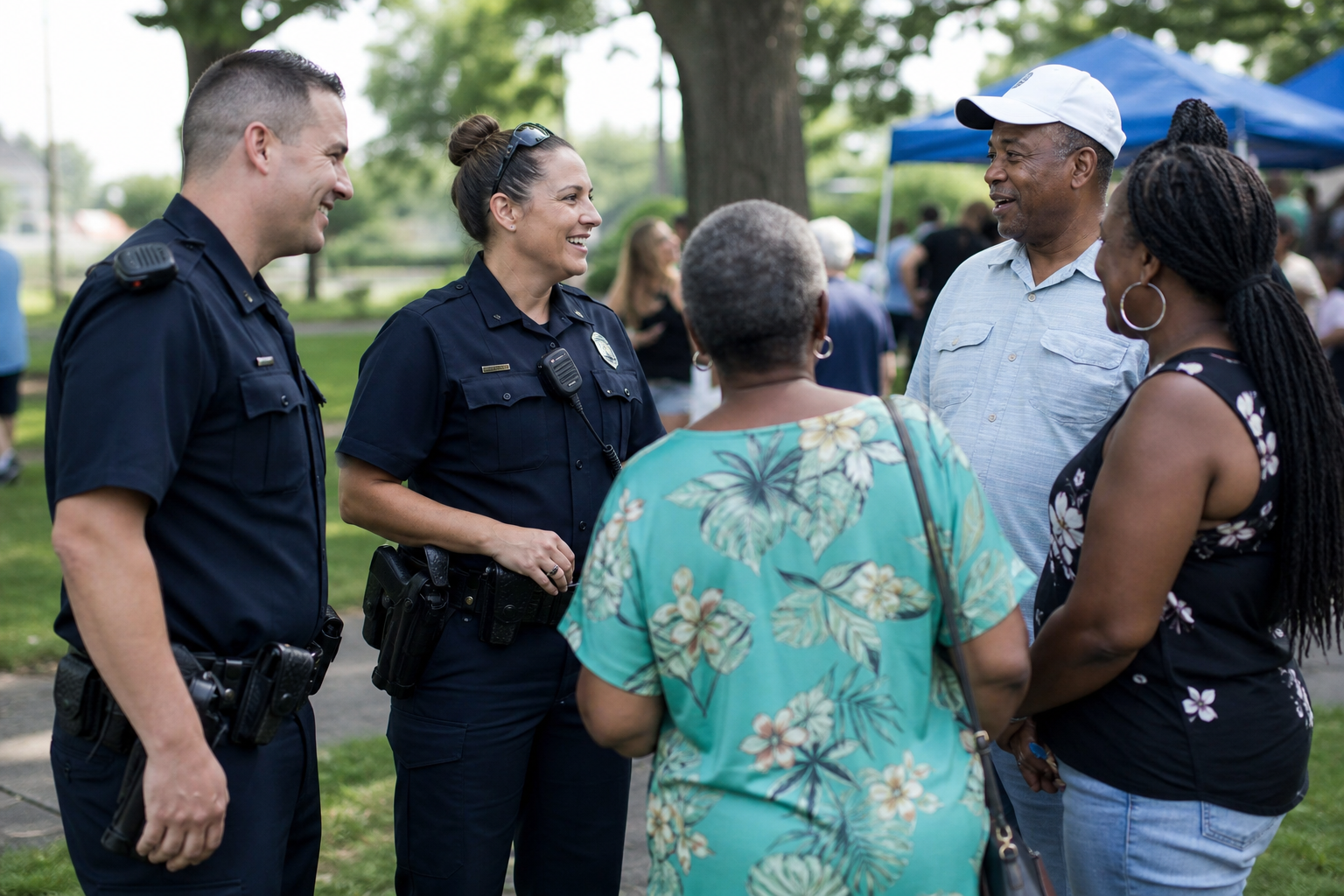
The strongest applications treat residents as a data source, not an audience, and can show what continues after the grant ends.
That is a narrative a reviewer can score, because every claim in it is checkable. There is nothing to take on faith.
And if the microgrant cycle simply does not line up with your budget year, CPD microgrants are only one of several routes worth knowing. Our roundup of seven grant programs that fund police community engagement technology walks through the alternatives, several of which move faster than the federal calendar.
Guardian Score helps agencies scope grant applications, from measurable trust outcomes to the sustainability plan reviewers look for. Get started.
Frequently asked questions
How much can a department receive from a CPD microgrant?
Awards run up to $175,000, though many funded projects request less, and in a recent cycle the COPS Office made 63 microgrant awards. Verify the current ceiling and categories at cops.usdoj.gov/grants, since terms change between cycles.
Are small departments realistic candidates for COPS microgrants?
Yes. The microgrant format was designed for focused, local pilots, and small and mid-sized agencies are funded regularly. A tightly scoped project with measurable outcomes beats a sprawling one from any size of agency.
Can grant funds pay for community feedback software?
Technology that directly enables community policing, including feedback and survey platforms, has historically fit CPD's scope, especially when it is tied to measurable trust outcomes. Confirm allowable costs in the current solicitation and ask your grant program specialist when in doubt.
When should we start preparing an application?
Before the solicitation opens. The agencies that win already have a project concept, a draft budget, and community partners identified when the window drops. If you begin writing the day it opens, you are usually too late to do it well.