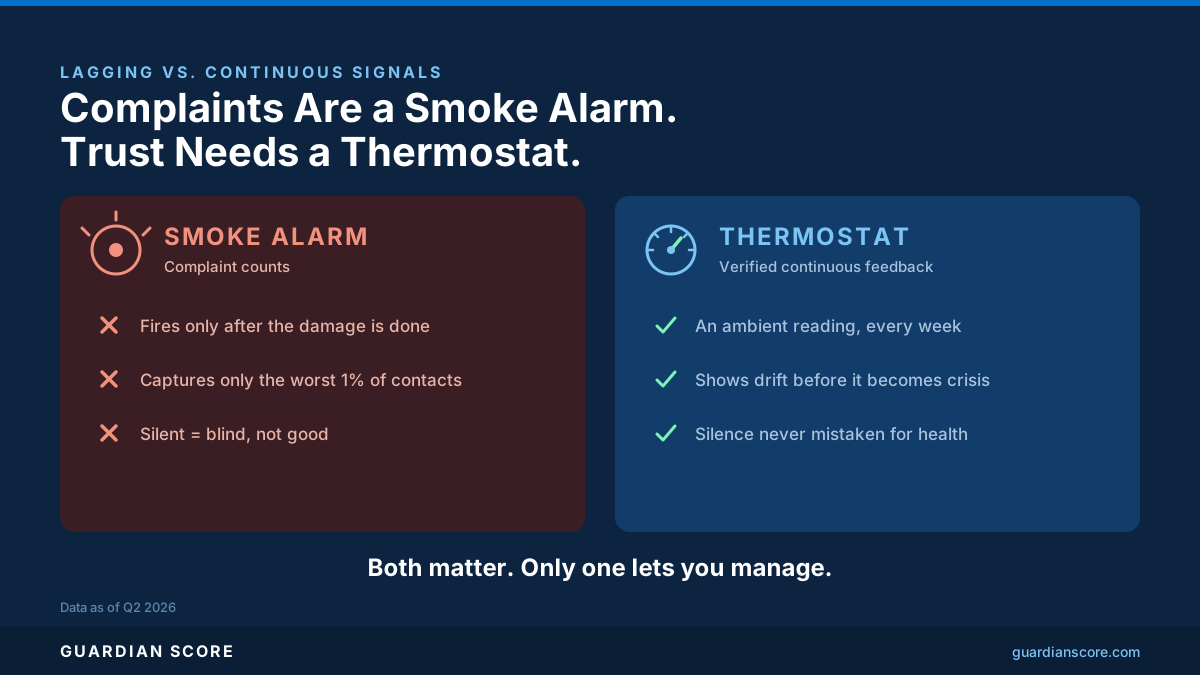
A smoke alarm is a useful device, but nobody heats their house with one. That is essentially what most departments are doing with community sentiment: the complaint process is the only sensor in the building, and it only sounds after something has already burned. Worse, it samples almost nothing - complaints capture roughly the worst one percent of encounters, so command staff steer an agency's reputation by its rarest and angriest data points.
This infographic draws the contrast plainly. On one side, the smoke alarm: reactive, binary, triggered after damage, silent about everything going well. On the other, the thermostat: a continuous, ambient reading of how encounters actually feel to the people in them - verified, officer-level, and available before a pattern becomes a headline. It is built for a command staff meeting or a council packet, where "we need more than complaints" usually needs a picture to land.
For the full argument behind the ambient reading, see How to Measure Community Trust in Policing.