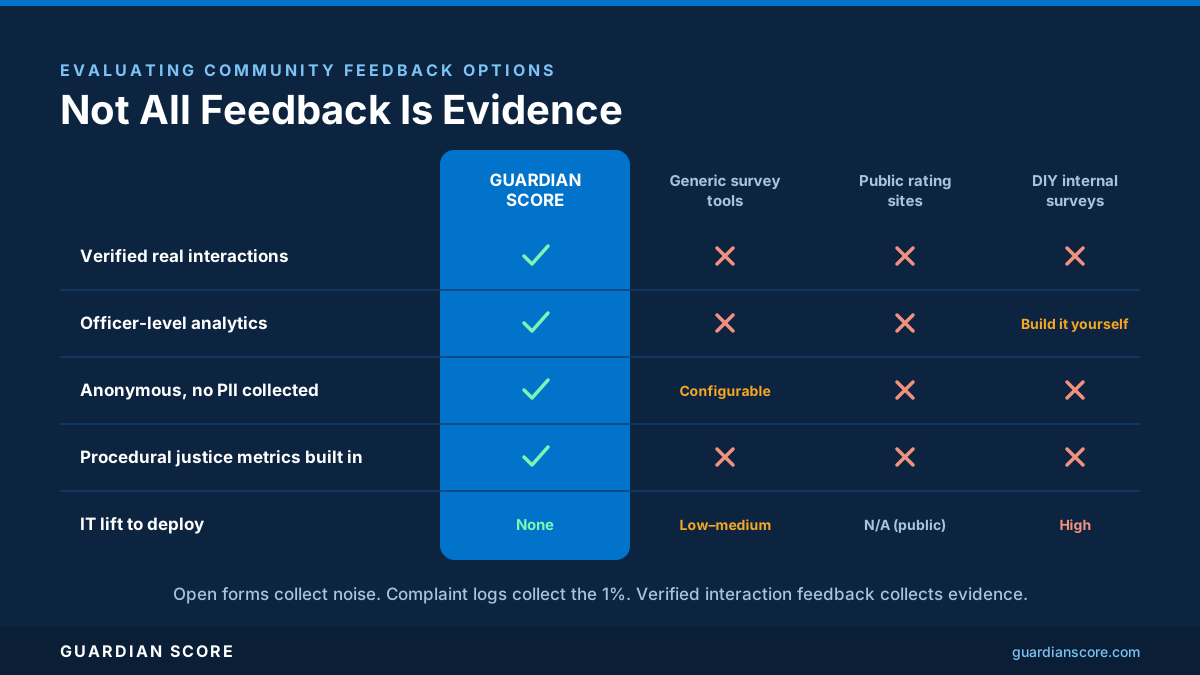
Somewhere in your evaluation, someone will say it: "Couldn't we just do this with a survey tool?" It's a fair question with a specific answer, because the options on the table - generic survey platforms, public rating sites, a homegrown form - all collect feedback. What they don't do is turn feedback into evidence a chief can act on or defend.
This infographic puts the alternatives side by side on the three dimensions that decide whether the data is usable. Verification: single-use QR cards tie every rating to a real interaction, where open web forms and rating sites accept anyone with a grievance and a browser. Officer-level analytics: a generic tool gives you a spreadsheet of responses; it doesn't build the per-officer trends that make coaching and recognition possible. And IT lift: DIY means someone on your staff owns forms, translation, and reporting indefinitely, versus a system with no IT integration, 26+ languages built in, and a two-to-four-week path to live. Use it in vendor evaluations, attach it to an RFP response, or hand it to the councilmember who suggested the free option.
For the measurement framework underneath the comparison, see How to Measure Community Trust in Policing - or request a walkthrough.