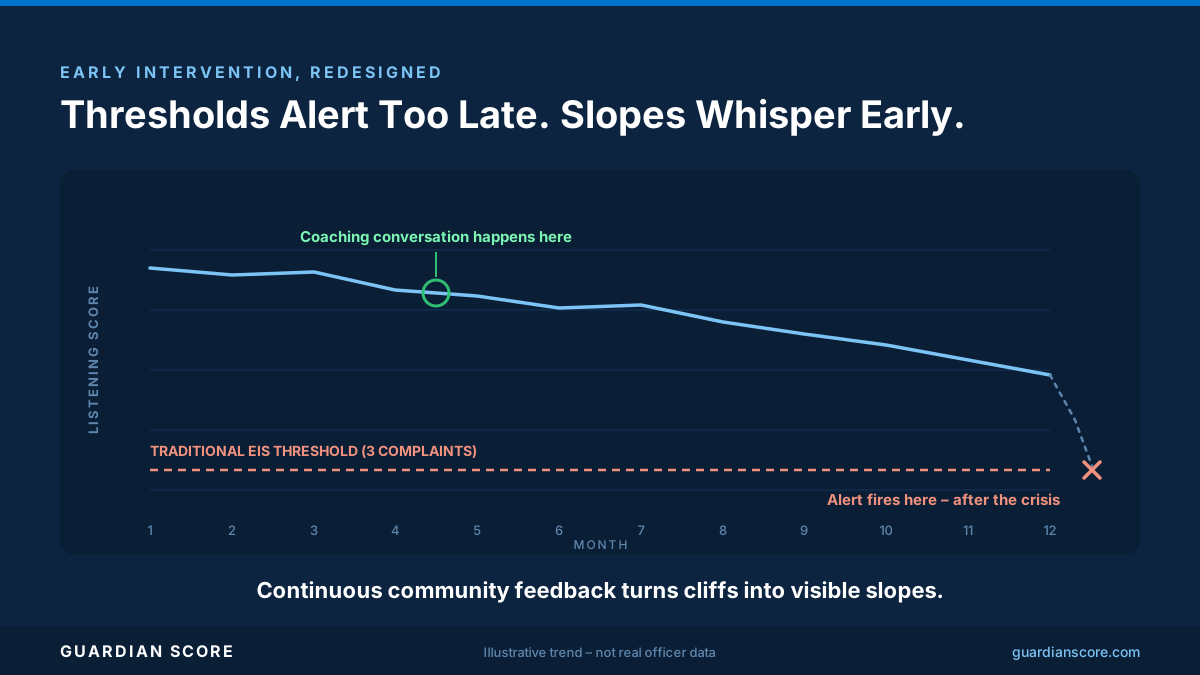
Traditional early intervention systems are built on thresholds: three use-of-force reports, two complaints in ninety days, and an alert fires. By design, that means the system speaks up only after something has already gone wrong - the officer is now a case file, the conversation is now formal, and the union is now in the room. Chiefs do not lack red flags; they lack the months of runway before the flag goes up.
This infographic contrasts the two curves. The threshold model is flat silence followed by a spike: no signal, no signal, crisis. The continuous-feedback model is a slope: community ratings on listening, fairness, and professionalism drifting downward across dozens of verified encounters, visible long before anything becomes reportable. A sergeant who sees the slope has a coaching conversation over coffee. A sergeant who waits for the flag has an internal-affairs referral. Same officer, same trajectory - entirely different intervention, cost, and outcome.
Share it with supervisors who inherited an EIS they have learned to ignore, or with command staff debating what "early" should actually mean. For the research on why threshold-based systems under-deliver, read Police Early Intervention Systems.